


Technical writing is changing. But the bigger transformation isn’t simply that artificial intelligence can produce documentation faster.
The more important question is whether we can use AI to make technical information clearer, more accurate, easier to maintain, and ultimately more trustworthy.
As someone whose career has included cybersecurity, technical writing, technical instruction, and government service, I’ve spent considerable time working with technical information that people depend on to make decisions.
A poorly written procedure can create operational problems. An ambiguous security control can lead to inconsistent implementation. An outdated technical manual can undermine even a well designed system.
AI offers some interesting opportunities to address these challenges. But it also introduces new ones, particularly around accuracy, traceability, accountability, and human oversight.
I wanted to explore these issues through actual software development rather than theoretical discussions.
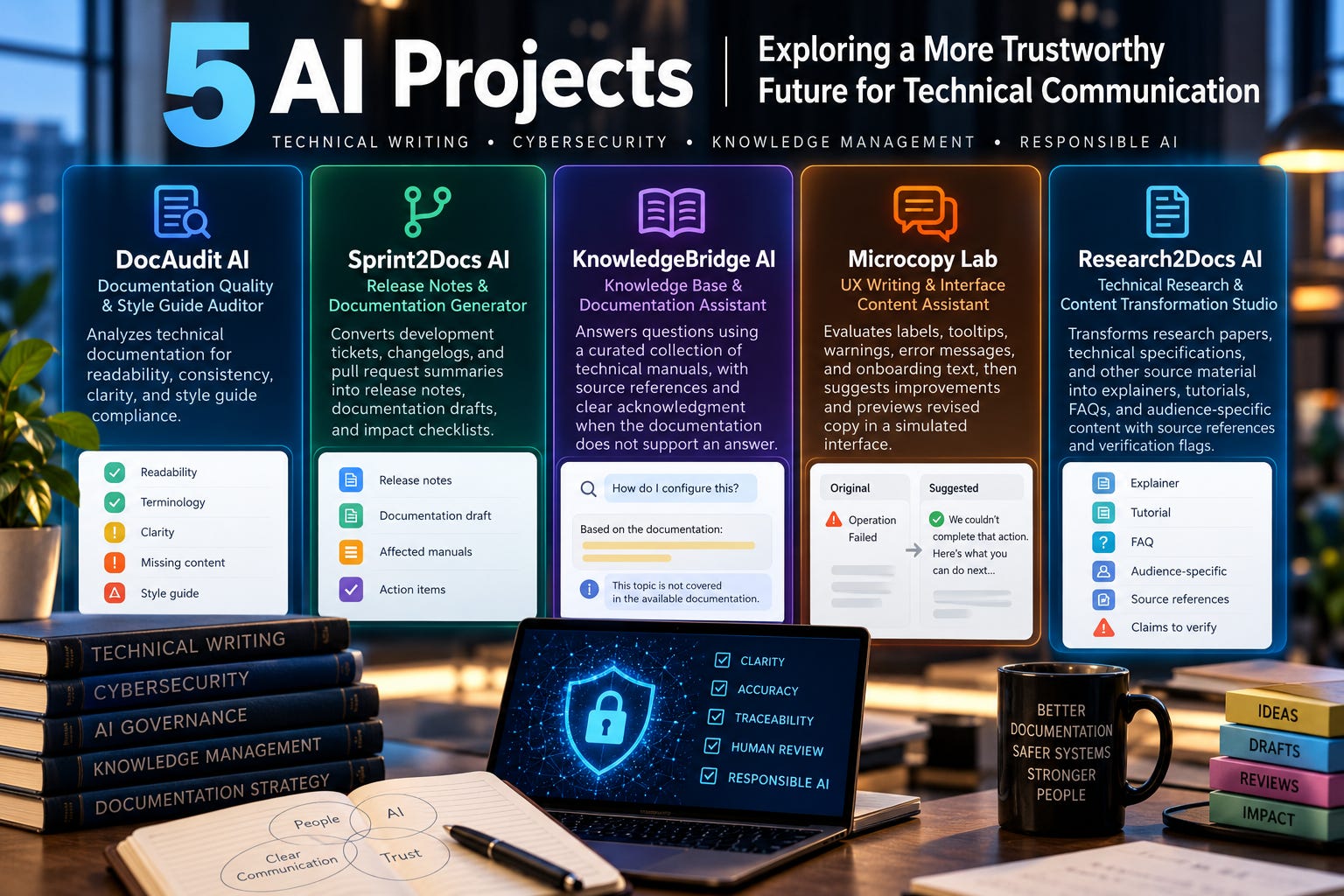
The result was five AI assisted projects designed to address different challenges in technical communication.
Each project serves a distinct purpose, but collectively they explore a larger idea: AI should strengthen human expertise, not become a substitute for it.
From Technical Writing to AI Assisted Workflows
Traditional technical writing involves far more than putting words on a page.
Technical writers interpret complex systems, interview subject matter experts, organize information, verify procedures, maintain terminology, and translate specialized knowledge into something an intended audience can actually use.
That responsibility becomes even more important in cybersecurity, compliance, and AI governance.
Consider a security policy that references an outdated control, a software release note that overlooks a breaking change, or a chatbot that confidently provides an answer unsupported by its documentation.
All three represent communication failures. All three can have consequences beyond the written word.
My objective with these projects was to explore how AI could assist with those problems while preserving the responsibilities of the technical writer.
Here is what I developed and the thinking behind each project.
1. DocAudit AI: Treating Documentation Quality as a Repeatable Process
The problem: Documentation quality is often evaluated manually, inconsistently, or only when a problem becomes apparent.
Different writers may use different terminology. Instructions may assume knowledge the reader doesn’t possess. Important explanations may be missing, and style guides can be difficult to enforce across large document collections.
DocAudit AI was created to address these challenges.
It analyzes technical documentation for readability, terminology consistency, unclear instructions, missing explanations, and style guide compliance.
The technical approach
The key architectural principle behind DocAudit AI is separating document analysis from the user interface.
The Python analysis engine operates independently of the Streamlit interface, allowing the underlying functionality to be maintained or reused without being tied to one presentation technology.
Ollama provides the planned local AI processing capability.
This separation matters because a documentation quality system should not depend on a particular interface to perform its core work.
There is also an important distinction between traditional validation rules and AI assisted analysis.
Some documentation issues can be evaluated through deterministic checks, such as prohibited terminology, required sections, or formatting conventions. Others, including unclear instructions and missing contextual explanations, require more interpretive analysis.
Combining these approaches creates opportunities for more useful reviews.
The lesson
AI can identify potential documentation problems, but it should not automatically become the final authority on whether a document is acceptable.
An unusual technical term may be entirely appropriate. A complex explanation may be necessary for an expert audience.
The goal is to give writers better evidence for editorial decisions, not remove their judgment.
2. Sprint2Docs AI: Closing the Gap Between Software Development and Documentation
The problem: Software often changes faster than the documentation describing it.
Development teams work with tickets, pull requests, changelogs, and issue trackers. Technical writers must interpret that information and determine what users, administrators, or developers need to know.
Unfortunately, the documentation impact of a change is not always obvious.
A seemingly minor code modification might affect an installation procedure, configuration setting, troubleshooting instruction, or security requirement.
Sprint2Docs AI explores how AI can assist with that translation.
The application converts development tickets, changelogs, and pull request summaries into release notes, documentation drafts, and checklists of potentially affected manuals.
The technical approach
The central challenge is not simply generating release notes. It is identifying what the supplied development evidence actually supports.
A development ticket might describe intended functionality rather than functionality that was successfully implemented. A pull request summary may omit operational consequences. A changelog entry may be too brief to determine whether an existing manual needs revision.
For that reason, an effective generation workflow must distinguish between information present in the supplied sources and conclusions requiring additional verification.
The documentation impact checklist is particularly important.
Rather than treating the generated release note as the entire deliverable, the system also supports the writer’s responsibility to identify related documentation requiring attention.
The lesson
One of the most valuable applications of AI in technical writing may be helping teams recognize documentation work that would otherwise be overlooked.
The goal isn’t merely faster content production. It is better coordination between engineering changes and the information users depend on.
3. KnowledgeBridge AI: Knowing When Not to Answer
The problem: Technical manuals contain enormous amounts of useful information, but finding the correct answer can be difficult.
Knowledge bases, product manuals, administrative guides, and operating procedures are often spread across multiple documents.
AI assistants promise a conversational interface to that information.
But there is an obvious risk: what happens when the documentation does not contain an answer?
KnowledgeBridge AI was designed around this concern.
It answers questions using a curated collection of technical manuals, references the supporting documents, and explicitly acknowledges when the available material does not support an answer.
The technical approach
The important design decision is to constrain the assistant to a defined body of documentation.
A typical approach to this problem involves retrieval augmented generation, or RAG, which retrieves relevant source passages and supplies them as context for an AI model.
However, retrieving a passage is not the same as proving an answer is correct.
A reliable documentation assistant must consider whether a retrieved passage actually supports the requested conclusion, whether relevant information is missing, and whether the source is appropriate for the question.
That creates a requirement for source traceability and a clear response when supporting evidence is insufficient.
The application is intended to make documentation easier to access without allowing the AI model’s general knowledge to masquerade as verified organizational guidance.
The lesson
Sometimes the most trustworthy answer an AI system can provide is:
“The available documentation does not contain enough information to answer that question.”
In technical support, cybersecurity, and compliance environments, that admission can be substantially more useful than a convincing but unsupported response.
4. Microcopy Lab: Why Small Words Can Have Large Consequences
The problem: Interface writing is often treated as a minor detail of software development.
But labels, tooltips, warnings, error messages, and onboarding instructions directly influence how users understand and interact with software.
Consider the difference between an error message that simply says “Operation Failed” and one that clearly explains what happened, what the user can safely do next, and whether any data was affected.
Poor interface content can increase confusion, support requests, and user mistakes.
In security sensitive applications, unclear wording can also contribute to unsafe decisions.
Microcopy Lab examines this often overlooked part of technical communication.
It evaluates interface text, suggests improvements, and allows revised copy to be previewed in a simulated interface.
The technical approach
The interesting challenge here is evaluating language within its actual context.
A warning that looks perfectly reasonable in isolation may become confusing when placed next to a particular button or displayed during an unfamiliar workflow.
Similarly, an error message must balance clarity with security.
Detailed diagnostic information can be valuable to developers, but exposing stack traces, internal paths, or sensitive implementation details to users can create unnecessary risks.
Microcopy Lab approaches interface content as part of the overall application experience rather than an isolated writing exercise.
The simulated interface allows writers to consider whether the suggested wording fits the user’s situation.
The lesson
Good UX writing is not just about making software sound friendlier.
It helps users understand the consequences of their actions, recognize important information, and recover from problems.
In that sense, interface writing is part of both usability and security engineering.
5. Research2Docs AI: Turning Complex Research Into Understandable Knowledge
The problem: Technical research is frequently difficult to communicate outside its original audience.
Research papers, technical specifications, engineering documents, and standards may contain information that is valuable to multiple groups, but those groups do not all need the same explanation.
A cybersecurity professional may want implementation details. A manager may need operational implications. A general reader may need an accessible explanation of the underlying concepts.
Research2Docs AI was developed to explore how AI can help transform complex source material into useful, audience specific content.
The application produces structured explainers, tutorials, FAQs, and other documentation formats while preserving source references and identifying claims that require verification.
The technical approach
The primary architectural challenge is maintaining the relationship between the original source and the transformed content.
Summarization alone is not enough.
Technical research frequently contains limitations, assumptions, qualifications, and conclusions that are meaningful only within a particular context.
If those qualifications disappear during rewriting, the result may be easier to read but less accurate.
An effective research transformation workflow needs to preserve source attribution, distinguish documented findings from interpretation, and make uncertainty visible.
The distinction between a verified claim, a reasonable inference, and an unsupported assertion is especially important.
Audience adaptation should change the explanation, not the underlying evidence.
The lesson
Making complex research understandable is not the same as simplifying it indiscriminately.
Good technical communication preserves the meaning, limitations, and supporting evidence behind the information.
AI can accelerate the transformation process, but the writer still has responsibility for accuracy and interpretation.
The Architectural Theme Connecting All Five Projects
Although the applications address different documentation problems, several design principles connect them.
First, separate the AI model from the surrounding workflow. Document processing, validation, interface behavior, and business logic should remain understandable and testable rather than being hidden inside one large prompt.
Second, preserve source information wherever possible. Whether generating release notes or answering documentation questions, the ability to trace a statement to its underlying material is fundamental to trust.
Third, make uncertainty visible. AI generated output should not silently convert incomplete information into confident conclusions.
Fourth, retain human review. A useful assistant helps technical writers identify problems, evaluate alternatives, and produce stronger documents. It should not imply that editorial judgment is unnecessary.
Finally, treat security and privacy as design considerations. Local AI processing can reduce dependence on external services and create opportunities for stronger data control, but local execution alone does not guarantee security. File handling, model behavior, dependency management, and application boundaries still matter.
These principles overlap with the larger discussion surrounding responsible AI and governance.
Frameworks such as the NIST AI Risk Management Framework emphasize the importance of managing AI risks throughout a system’s lifecycle.
The exact controls and safeguards will vary by application, but the underlying questions are relevant even to comparatively small software projects.
What information is the AI system using?
What can it do with that information?
How do we recognize errors?
And who is accountable for the resulting output?
What These Projects Taught Me About AI and Technical Writing
Working through these five applications reinforced something I have increasingly come to believe.
The future of technical writing is not simply about becoming better at prompting an AI model.
It is about understanding how information moves through systems, how evidence supports claims, and how automated workflows can assist experts without hiding uncertainty or compromising accountability.
It also highlights the increasingly interdisciplinary nature of technical communication.
A modern technical writer may benefit from understanding software architecture, APIs, version control, information retrieval, cybersecurity, accessibility, and AI model limitations.
That does not mean every writer needs to become a full time software developer.
It means that the boundaries between writing, engineering, knowledge management, and governance are becoming more interconnected.
These projects have also helped me connect my professional background in technical writing and cybersecurity with my continuing academic interests in AI security controls, governance, and algorithmic harm.
They are practical software tools, but they are also experiments in a much larger question:
How do we design AI assisted systems that remain useful, transparent, and accountable to the people who depend on them?
Where I Hope to Take This Work
One reason I built these projects was to demonstrate that technical writing skills can extend well beyond traditional documentation deliverables.
There are opportunities to help organizations improve documentation workflows, make internal knowledge more accessible, develop stronger editorial quality controls, and communicate emerging technologies more effectively.
I am particularly interested in contributing to these areas through technical writing, documentation strategy, research communication, and consulting engagements.
My focus remains on work where clear communication, technical accuracy, and responsible technology use intersect.
The five applications represent different examples of what that combination can produce.
They also provide a foundation for continued experimentation and learning.
A Final Thought
AI may help us produce documentation faster. But speed alone is not the measure of successful technical communication.
What matters is whether the reader can understand the information, trust its accuracy, recognize its limitations, and use it to make an informed decision.
If AI helps us accomplish those goals, it becomes a meaningful tool for technical writers.
If it simply produces more text without evidence or accountability, we have not necessarily improved anything.
For those working in technical writing, software development, cybersecurity, or AI governance:
Where do you see the greatest opportunity for AI to improve technical communication, and what safeguards do you believe are essential before we trust it with more of that work?