



Your organization has spent years establishing its Information Security Management System (ISMS). You have documented policies, risk registers, internal audit schedules, corrective action procedures, and management reviews.
Now artificial intelligence enters the picture, and leadership wants ISO/IEC 42001 certification.
Does that mean building an entirely new governance program?
Not necessarily.
Organizations operating under ISO/IEC 27001 already possess much of the management infrastructure necessary to support AI governance. The challenge is extending those established processes to address risks that traditional information security controls were never designed to evaluate.
ISO/IEC 42001:2023 provides a management system framework for organizations developing, providing, or using artificial intelligence. Its focus includes responsible AI practices, transparency, risk management, and continual improvement.
For GRC professionals, the opportunity is substantial: reuse what works, identify what is missing, and develop an auditable AI Management System (AIMS).
1. Start with the Management System, Not the Controls
One of the biggest implementation mistakes is immediately jumping into Annex A controls without first evaluating existing governance structures.
ISO/IEC 27001 and ISO/IEC 42001 share a familiar management system architecture.
Both address organizational context, leadership responsibilities, planning, support, operations, performance evaluation, and continual improvement.
This creates opportunities to reuse established processes.
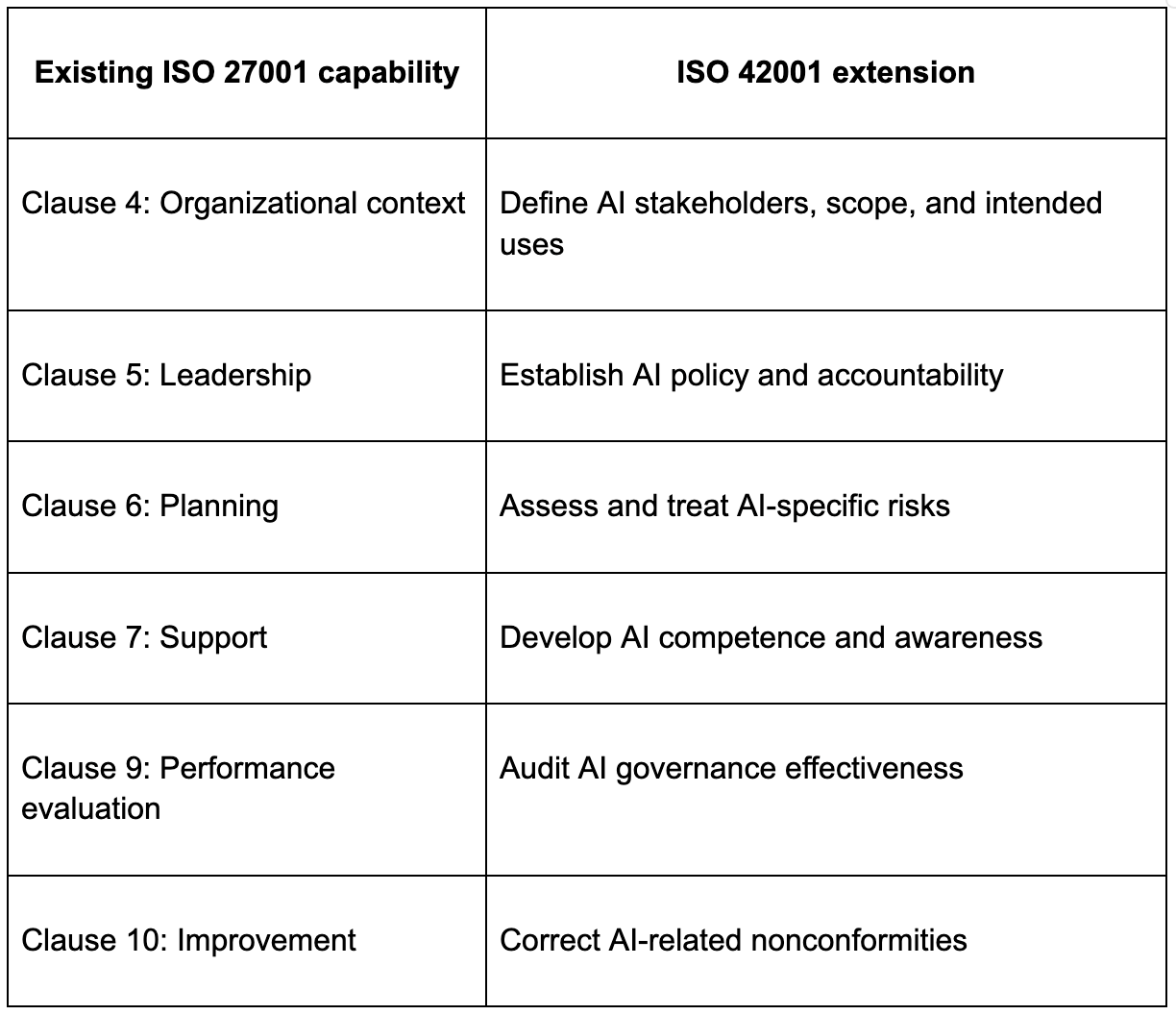
Illustrative management system alignment, not an official ISO equivalence matrix.
An organization might already maintain an enterprise risk committee, a centralized policy repository, and an annual audit program.
Rather than duplicating these functions, GRC teams can incorporate AI governance into existing structures.
However, shared management processes do not automatically establish conformity with ISO/IEC 42001.
The evidence must demonstrate that those processes actually address AI-specific risks.
2. Map Existing Security Controls to AI Governance
The next step is performing a structured control-mapping exercise.
ISO/IEC 27001:2022 Annex A contains security controls addressing organizational, people, physical, and technological risks. Many provide a useful foundation for AI governance, but their applicability must be evaluated individually.
Example control mapping
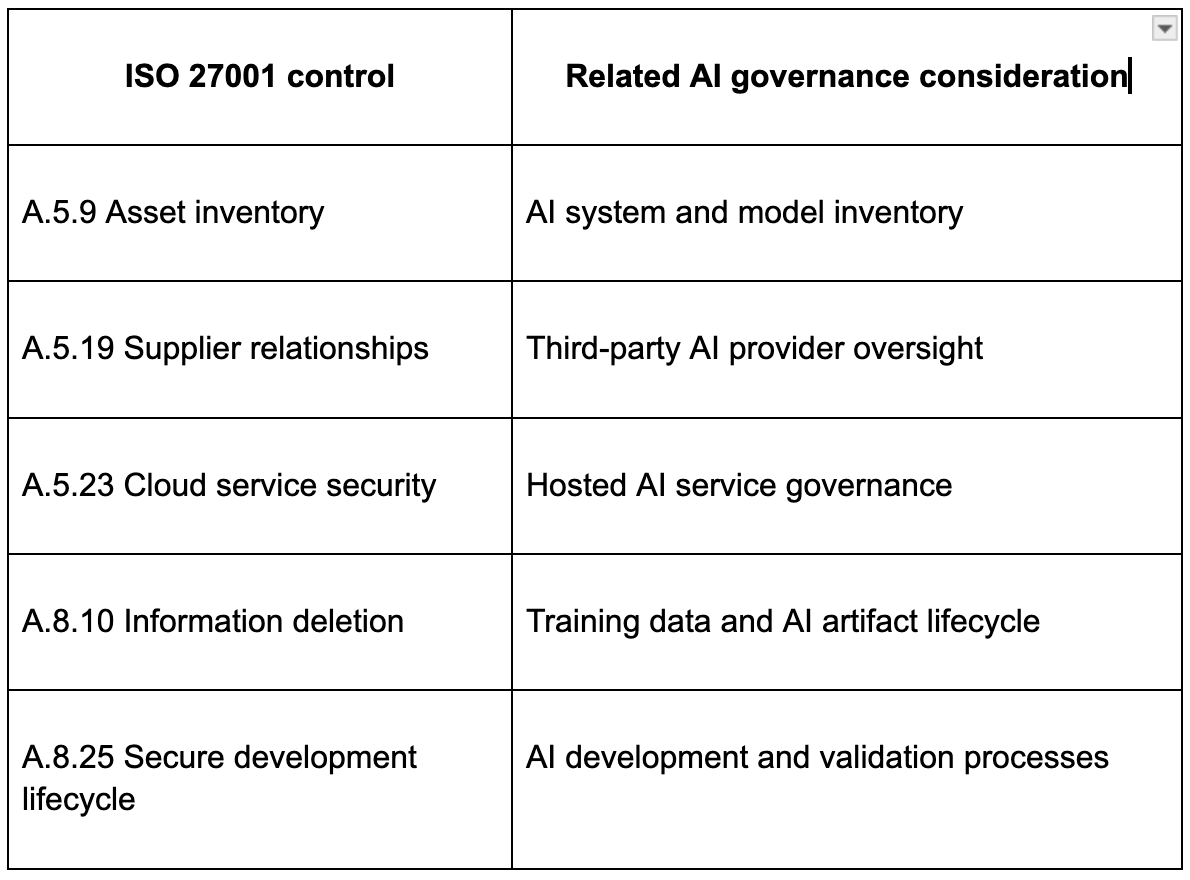
An important distinction for auditors is that control reuse does not establish control equivalence. Existing ISO 27001 controls can support ISO 42001 implementation, but each must be evaluated against the organization’s AI-specific risks, applicable requirements, and expected evidence. Mapping controls is the beginning of the assessment, not proof of conformity.
These are practical relationships, not automatic control equivalencies.
An existing asset inventory might contain servers, databases, and software applications while omitting model versions, training datasets, prompts, and external AI dependencies.
Similarly, supplier assessments might address contractual security obligations without examining model limitations, training data transparency, or AI-generated output risks.
The GRC team’s responsibility is to identify those differences and document the additional controls or evidence required.
The central question becomes:
Does this security control also manage the relevant AI risk, or does it merely protect the infrastructure surrounding the AI system?
3. Build an AI-Specific Risk Treatment Plan
ISO/IEC 42001 Clause 6.1.3 addresses AI risk treatment, including control selection, applicability decisions, treatment planning, management approval, and residual risk acceptance. Clause 6.1.4 separately addresses AI system impact assessment.
Traditional security risk registers commonly examine confidentiality, integrity, and availability.
AI introduces additional dimensions, including fairness, reliability, transparency, human oversight, and consequences for affected individuals.
Consider an organization deploying an AI-assisted employee screening system.
Its risk assessment might identify discriminatory recommendations, unreliable outputs, questionable training data provenance, and insufficient human review.
A practical AI Risk Treatment Plan should document:
Risk identification: Describe the AI system, intended purpose, and potential harms.
Risk assessment: Evaluate likelihood and consequences using defined criteria.
Control selection: Identify relevant ISO/IEC 42001 Annex A controls and additional safeguards.
Treatment ownership: Assign responsible individuals, deadlines, and required resources.
Residual risk acceptance: Obtain approval from designated management and retain supporting evidence.
An AI Statement of Applicability should also explain which controls are necessary and justify inclusions and exclusions.
The important distinction is that an AI risk treatment plan must address more than technical security weaknesses. It must account for how an AI system may affect people and organizational decisions.
4. Train Internal Auditors to Examine the AI Lifecycle
An experienced ISO 27001 auditor already understands sampling, objective evidence, nonconformities, corrective actions, and audit independence.
Those skills remain valuable.
What changes is the subject matter.
AI auditors need sufficient competence to evaluate risks throughout the AI lifecycle, including system design, data acquisition, development, validation, deployment, monitoring, and retirement.
Three areas deserve particular attention.
Data provenance: Can the organization establish where relevant datasets originated, how they were obtained, and whether their permitted uses support the AI system’s intended purpose?
Bias and fairness: Has the organization identified relevant populations, selected appropriate evaluation methods, and documented limitations or disparities? A single aggregate accuracy score is rarely sufficient to establish fairness.
Societal impact: Has the organization evaluated foreseeable consequences for individuals, communities, and other affected stakeholders?
The NIST AI Risk Management Framework Playbook complements these activities through its Govern, Map, Measure, and Manage functions. NIST emphasizes considering AI risks throughout the system lifecycle, including social and contextual factors.
Internal auditors do not necessarily need to become machine-learning engineers. They must, however, recognize when specialist evidence or technical expertise is necessary.
5. Conduct the Internal Audit and Close the Gaps
With controls mapped and auditors prepared, the organization can execute its AI internal audit under ISO/IEC 42001 Clause 9.2.
A practical audit should examine governance documentation, interview responsible personnel, sample AI systems, and verify that documented controls operate as intended.
For example, an auditor reviewing a generative AI application might request model approval records, evaluation results, incident logs, monitoring evidence, and documentation of human oversight.
The auditor should test whether those records support the organization’s stated risk controls, rather than simply confirming that documents exist.
Audit findings should feed into corrective action tracking and management review. Remediation requires assigned owners, supporting evidence, and verification that corrective actions were effective.
For additional structure, ISO/IEC 42005:2025 provides guidance on AI system impact assessments, including potential consequences for individuals and society.
AI system impact assessment
6. Prepare for Certification Without Confusing the Audit Types
Internal audits and certification audits serve different purposes.
Internal audits evaluate the organization’s management system and identify opportunities for corrective action. Certification audits involve an independent certification body evaluating conformity against the applicable standard.
Published in July 2025, ISO/IEC 42006:2025 establishes additional requirements for bodies auditing and certifying AI management systems.
ISO
An existing ISO 27001 certification can support ISO 42001 preparation, but it does not automatically confer AI management system certification.
Organizations should establish their AIMS scope, complete risk and impact assessments, demonstrate control effectiveness, conduct internal audits, and complete management review before pursuing certification.
The Bigger Picture: From Security Compliance to Responsible AI
ISO/IEC 42001 represents an evolution in organizational governance.
Traditional cybersecurity programs concentrate on protecting systems, information, and operations. AI governance must also consider the consequences of decisions and outputs produced by those systems.
For organizations with mature ISO 27001 programs, the foundation already exists. Governance processes, audit expertise, and evidence management practices can be extended rather than replaced.
The goal is not to create more compliance paperwork. It is to establish defensible, repeatable processes demonstrating that AI risks are identified, evaluated, treated, and monitored.
Ultimately, AI governance maturity is measured not by how many policies an organization produces, but by whether those policies translate into effective controls and verifiable evidence.
Here’s the question for GRC and cybersecurity professionals: If your organization underwent an ISO 42001 internal audit tomorrow, would your existing ISO 27001 evidence demonstrate responsible AI governance, or would it reveal an entirely new category of unmanaged risk?
Primary references and further reading
The following authoritative sources support the article. The control mapping is an illustrative implementation approach, not an officially endorsed ISO crosswalk.