


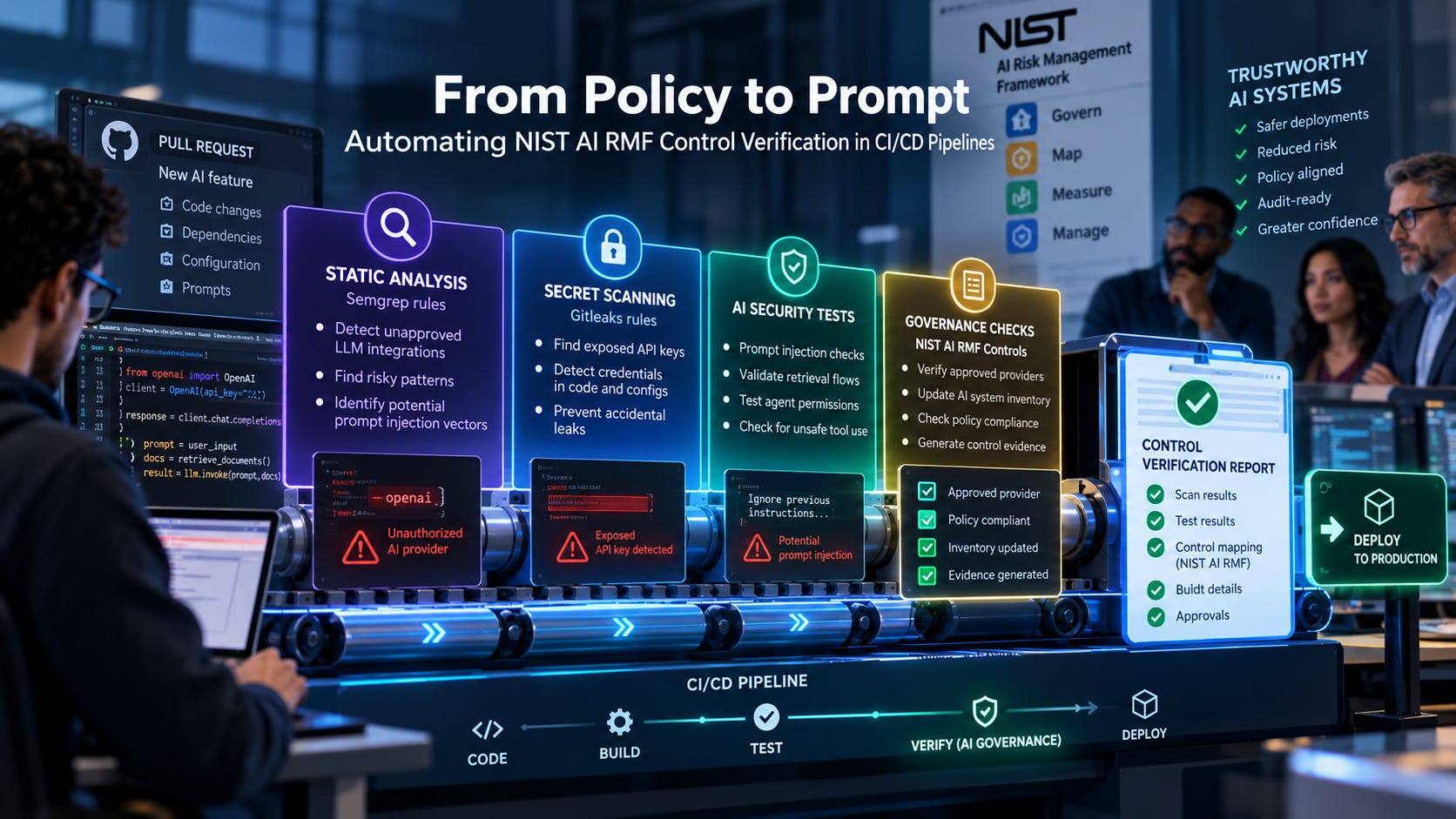
Imagine an organization that has spent months developing its AI governance program. It has an approved AI use policy, documented risk assessments, designated oversight responsibilities, and a carefully maintained register of authorized AI systems.
Then a developer adds an integration with an unapproved large language model (LLM) provider. Another developer accidentally commits an API credential. A third introduces a retrieval workflow that passes untrusted documents directly into an AI agent with access to sensitive business operations.
The organization’s governance documents remain perfectly intact.
Its actual security posture, however, has changed.
This illustrates one of the central challenges of modern AI governance: A policy can describe acceptable behavior, but it cannot guarantee that software follows it.
What if organizations could detect selected violations before those changes ever reached production?
That is the opportunity presented by integrating AI governance verification into continuous integration and continuous delivery (CI/CD) pipelines.
Why Traditional AI Governance Is Struggling to Keep Up
AI governance frequently operates on a different schedule from software development.
Security teams conduct assessments. Legal teams examine privacy obligations. Risk managers update control documentation. Meanwhile, developers continuously introduce new models, APIs, dependencies, prompts, and AI-powered features.
Traditional governance reviews may occur quarterly or during major releases. Software changes can happen daily.
This difference creates a visibility gap.
A system approved in January may have substantially different capabilities by March. Its model provider may change, its access privileges may expand, or its retrieval pipeline may begin processing new categories of information.
The NIST AI Risk Management Framework addresses this broader challenge through four interconnected functions: Govern, Map, Measure, and Manage.
NIST emphasizes that managing AI risk is a continuous activity throughout the AI system lifecycle. Its Govern 1.5 outcome explicitly addresses ongoing monitoring and periodic review of risk management processes.
That creates an opportunity to connect governance requirements with engineering workflows.
Rather than asking whether a development team followed policy months after deployment, organizations can automatically check selected requirements whenever relevant software changes occur.
Shift AI Risk Management Left
Cybersecurity professionals are familiar with shifting left, the practice of identifying and addressing security weaknesses earlier in software development.
The same concept can be applied to AI risk management.
An AI-focused CI/CD pipeline can evaluate code, dependencies, configuration files, and selected model behaviors before deployment.
Consider three practical examples.
1. Detecting unauthorized AI integrations
Suppose an organization permits only approved LLM providers.
A developer introduces a connection to an external model API that has not undergone the required security or privacy review.
A customized static analysis rule can flag known unauthorized SDK imports, endpoints, or API invocation patterns.
The pipeline can then require an approval or block the release.
Tools such as Semgrep support custom rules for detecting prohibited code patterns and unsafe API usage.
However, static analysis cannot guarantee discovery of every integration. Dynamically constructed URLs, indirect dependencies, and runtime configuration changes require additional controls.
2. Preventing credential exposure
Developers integrating commercial AI services frequently work with API keys and other authentication credentials.
Accidentally committing those credentials can expose an organization to unauthorized service usage, financial charges, and potential data access.
Gitleaks provides repository scanning for exposed secrets and supports customized detection rules.
Integrating secret scanning into pull requests can prevent detected credentials from progressing through the development pipeline.
Secret scanning is not an AI-specific capability, but it provides meaningful protection for AI integrations.
3. Identifying potential prompt injection weaknesses
Prompt injection is especially challenging because malicious instructions can enter through user messages, retrieved documents, websites, or other untrusted sources.
The OWASP guidance on prompt injection explains how attacker-controlled inputs can influence an LLM to produce unintended outputs or actions.
OWASP Gen AI Security Project
Static analysis can identify suspicious architectural patterns, such as untrusted retrieval content flowing toward privileged agent operations without appropriate validation or authorization boundaries.
But detecting risky code patterns is not equivalent to proving that a system resists prompt injection.
That requires additional behavioral testing, adversarial evaluations, privilege restrictions, and runtime monitoring.
Turning NIST AI RMF Outcomes Into Automated Checks
The practical breakthrough comes from connecting development tests to documented governance objectives.
Not every NIST AI RMF outcome lends itself to automated verification. Some require organizational judgment, stakeholder involvement, or evaluation of broader societal impacts.
Others can be partially supported through repeatable engineering evidence.
The following illustrates a proposed implementation, not an official NIST-prescribed control mapping.
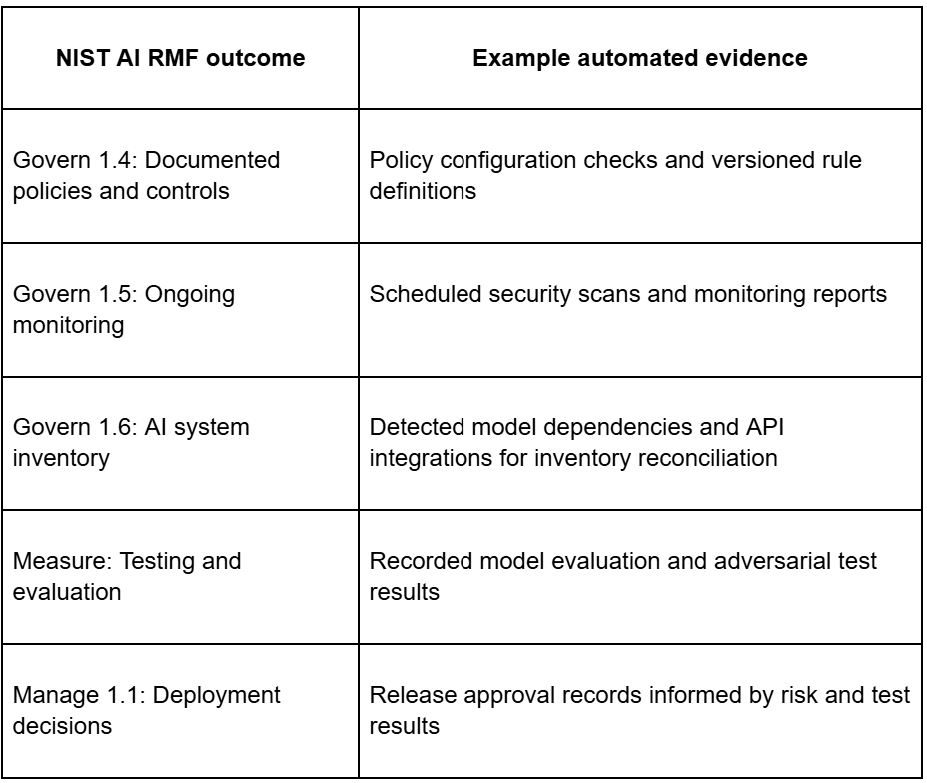
These outcomes are described in the NIST AI RMF Core and Playbook. The automation examples are implementation suggestions rather than official compliance tests.
The value is not simply finding vulnerabilities.
It is creating a traceable relationship between an organization’s governance expectations and the software it actually deploys.
What an AI Governance Pipeline Could Look Like
A practical implementation could introduce a governance verification stage into an existing DevSecOps workflow.
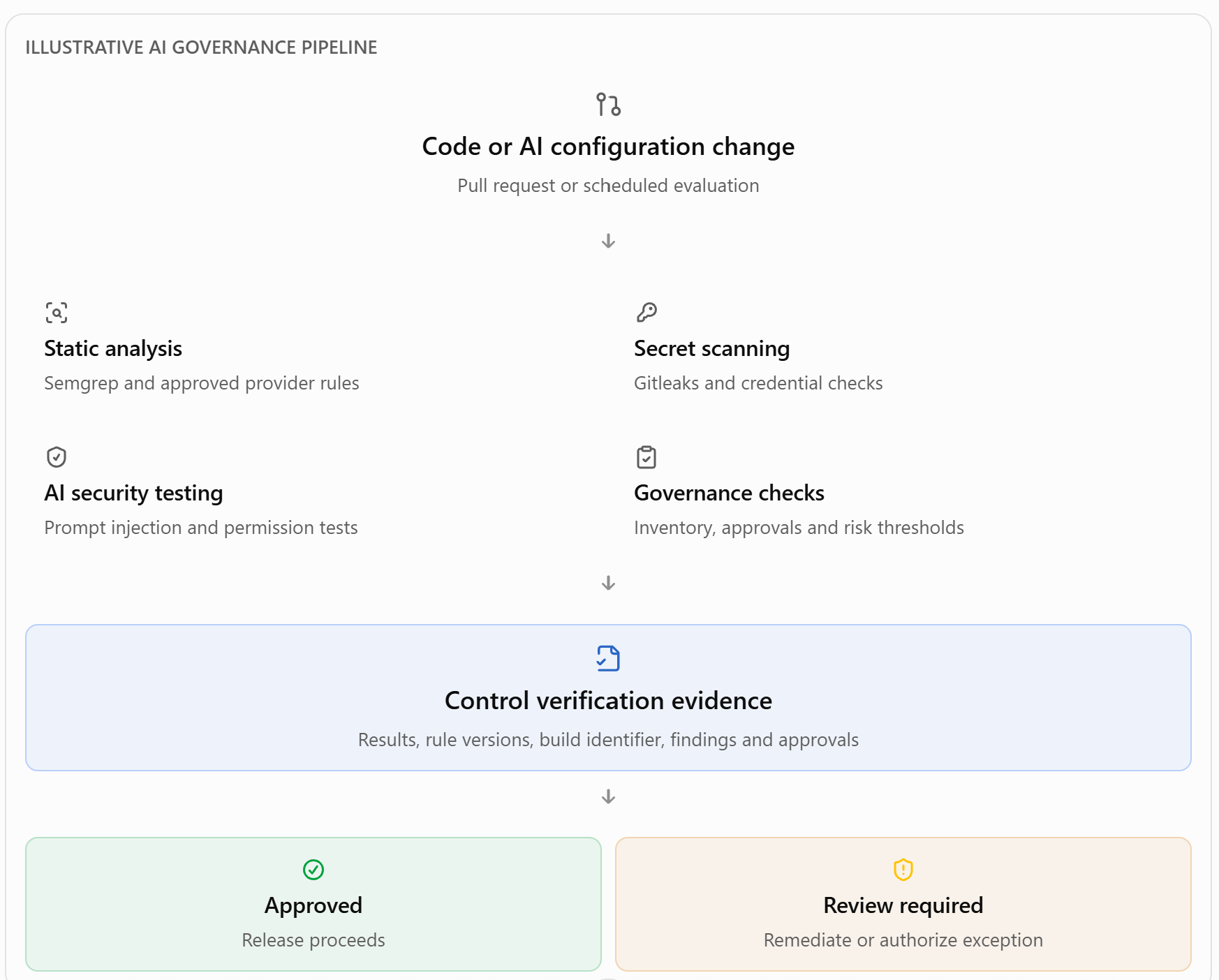
A successful build would not automatically mean that an AI system is compliant or trustworthy.
Instead, it would mean that the system satisfied a defined set of automated checks, using specific rules and test conditions at a particular point in time.
That distinction is essential for credible reporting.
Making Automated Evidence Useful to Auditors
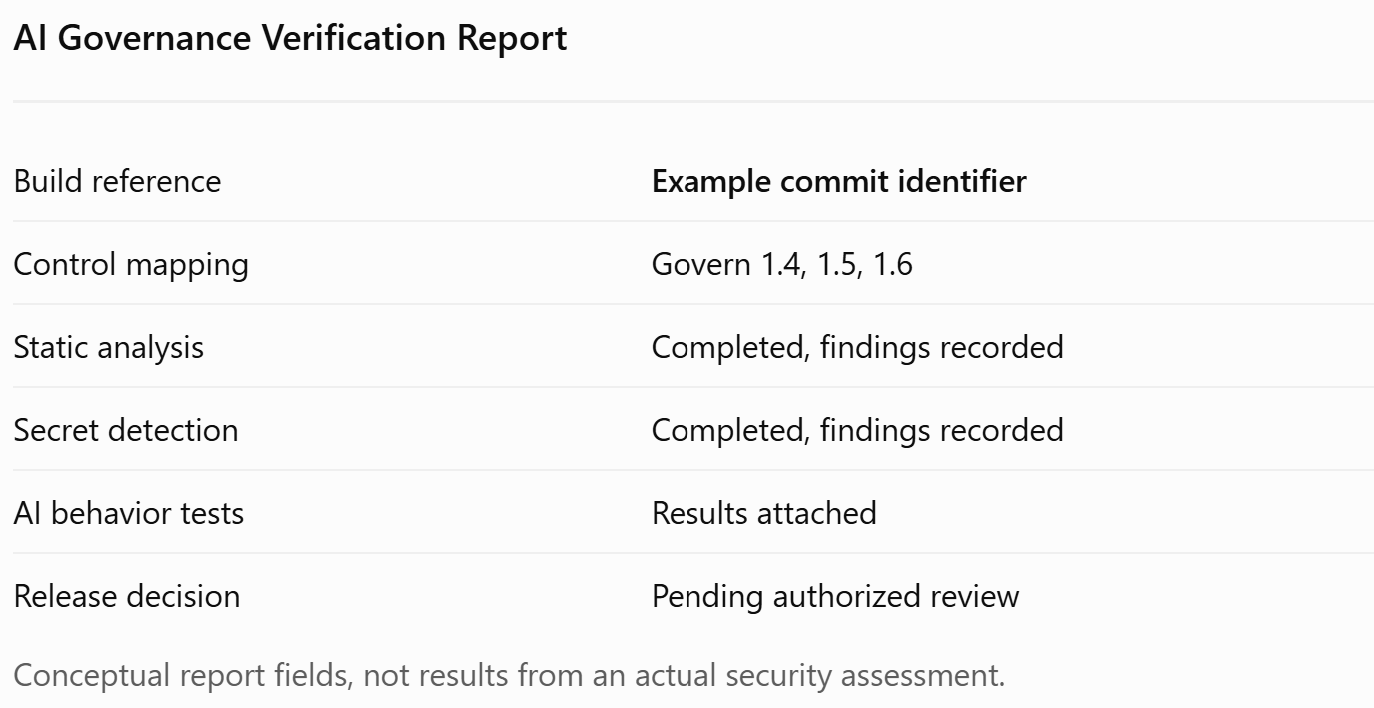
One of the most valuable outcomes of this approach is the ability to generate repeatable control verification evidence.
A pipeline can record which tests were executed, which versions of the rules were applied, what findings were produced, and whether remediation or documented exceptions were required.
For example, an internal verification report might contain:
Tools supporting SARIF, the Static Analysis Results Interchange Format, can also export machine readable findings for security dashboards and review workflows.
GitHub’s documentation describes how compatible third-party security analysis results can be incorporated into code scanning.
For GRC teams, these records can provide evidence of technical verification activities.
For security teams, they establish repeatable checks.
For developers, they provide actionable feedback while changes are still relatively easy to correct.
However, reports should distinguish between a test that passed, a control that was partially verified, and a broader governance outcome that still requires human assessment.
The Limits of Automation
Automated checks are valuable, but organizations must avoid confusing test coverage with complete AI risk management.
A static analysis tool cannot independently determine whether an AI system is fair across affected populations, whether its use is appropriate in a particular social context, or whether its outputs create unacceptable real-world consequences.
Similarly, passing a collection of prompt injection tests does not establish immunity from future attacks.
AI behavior can change when models, prompts, retrieval sources, connected tools, or operating conditions change.
NIST’s Generative AI Profile (AI 600-1) reinforces the need to manage generative AI risks throughout the lifecycle rather than relying on a single verification exercise.
The stronger approach combines automated checks with human oversight, periodic reassessment, runtime controls, and incident response.
AI governance should operate continuously, not terminate when a deployment succeeds.
Start Small, Then Expand
Organizations do not need an entirely new governance platform to begin.
Start by identifying a few measurable requirements within the existing AI policy.
Require developers to use approved AI providers. Scan repositories for exposed credentials. Test sensitive agent operations against defined authorization requirements. Preserve the resulting evidence alongside software releases.
Next, connect those checks to an AI system inventory and a documented exception approval process.
Finally, expand into behavioral evaluations, monitoring, and risk-based release decisions.
The objective is not to automate every governance decision.
It is to automate what can be reliably verified while preserving human accountability for decisions that require judgment.
The Future of AI Governance Is Executable
AI governance is entering a phase in which written policies alone are no longer sufficient.
Organizations need to understand not only what their AI policies require, but whether engineering systems consistently implement those requirements.
CI/CD integration offers a practical way to bring security, engineering, and GRC teams into the same operational process.
It transforms selected policies into testable conditions, generates evidence during development, and identifies problems before they become production incidents.
The broader lesson is straightforward: AI governance should not exist separately from the systems it is intended to govern.
It should become part of how those systems are built, tested, approved, and monitored.
A question for readers:
If your organization already requires security scans before software deployment, should AI governance verification become an equally important release requirement, or are there risks in allowing automated checks to influence decisions that traditionally require human judgment?