


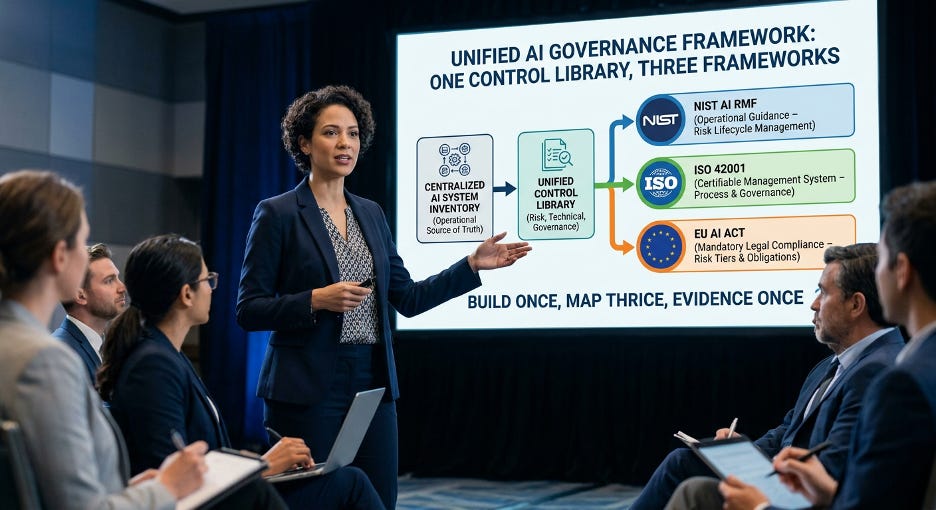
Here’s how.
If your organization is running separate workstreams for the EU AI Act, ISO 42001 certification, and NIST AI RMF alignment, you are doing triple the work for the same outcome.
The legal team owns the EU AI Act compliance project. The security team is pursuing ISO 42001 certification because customers are asking for it. And the risk team adopted the NIST AI RMF as their operational framework. Three teams. Three frameworks. Three sets of documentation. Three AI inventories that don’t match.
This fragmentation is not just inefficient, it creates real compliance risk. When frameworks are treated as independent tracks, gaps emerge. AI systems get documented in one register but not another. Controls implemented for one framework don’t get credited toward others. Auditors find inconsistencies. And regulators don’t care about your organizational silos.
The smarter path exists: one unified control library, mapped to all three frameworks, generating one set of evidence.
Know What You’re Dealing With
Before you can align them, you need to understand what each framework actually is.
● EU AI Act (Mandatory Law): Applies to any organization placing AI systems on the EU market or whose AI system outputs are used in the EU, regardless of headquarter location. Non-compliance carries fines up to €35 million or 7% of global annual turnover for prohibited practices, with lower tiers of up to €15 million or 3% for other high-risk violations. The high-risk regime for Annex III systems was set to apply from August 2026, but the AI Omnibus amendments that took effect in July 2026 pushed that deadline to December 2027. This is not optional, only delayed.
● ISO 42001 (Certifiable Management System): Voluntary, but enterprise customers increasingly demand it in procurement. Following the Plan-Do-Check-Act structure, it requires a third-party audit for certification. It does not equal EU AI Act compliance, but provides the governance architecture to support it.
● NIST AI RMF (Voluntary Operational Guidance): No certification, no legal enforcement. However, it serves as the shared vocabulary of AI risk in the United States, referenced in federal procurement and expected by enterprise partners. Its four functions, Govern, Map, Measure, Manage provide a practical structure for your risk management lifecycle.
These are not competing choices. They are complementary layers of a complete AI governance program:
● The EU AI Act sets the legal floor.
● ISO 42001 makes your program provable through certification.
● NIST AI RMF runs the engine as the day-to-day operational method for managing risk.
The Inventory: Your Single Source of Truth
All three frameworks require an AI system inventory.
NIST AI RMF states it directly: mechanisms must be in place to inventory AI systems. The EU AI Act requires providers to register high-risk AI systems in the EU database. ISO 42001 Clause 8 mandates operational documentation for every AI system under management.
Build one unified inventory rather than three separate ones. The maintenance burden of separate inventories outweighs any structural benefit.
At a minimum, your single source of truth must capture:
● Identification: System name, owner, purpose, intended use.
● Data Classification: Training data sources, data handling, sensitive data categories.
● Technical Architecture: Model type, infrastructure, integration points.
● Governance: Risk classification, compliance status, oversight documentation.
Start with the NIST fields as your baseline. ISO 42001 and the EU AI Act layer on a handful of additional fields, some of which belong in your gap register rather than the main inventory.
The primary operational challenge is completeness. Production systems are easy to catalog; the blind spots are shadow deployments, the GPT wrapper in a marketing spreadsheet, the vendor tool that quietly added an AI feature last quarter, or the Slack bot running sentiment analysis. Seventy percent coverage gives your auditor false confidence while thirty percent runs ungoverned.
How to Align Your Controls: Feasibility vs. Fantasy
A single control library mapped across all three models is achievable, but only if you avoid treating them as direct, 1:1 text translations. Core operational requirements like human oversight, risk assessments, data lineage, and model logging substantially overlap. However, because each framework serves a different purpose, the level of direct equivalence varies:
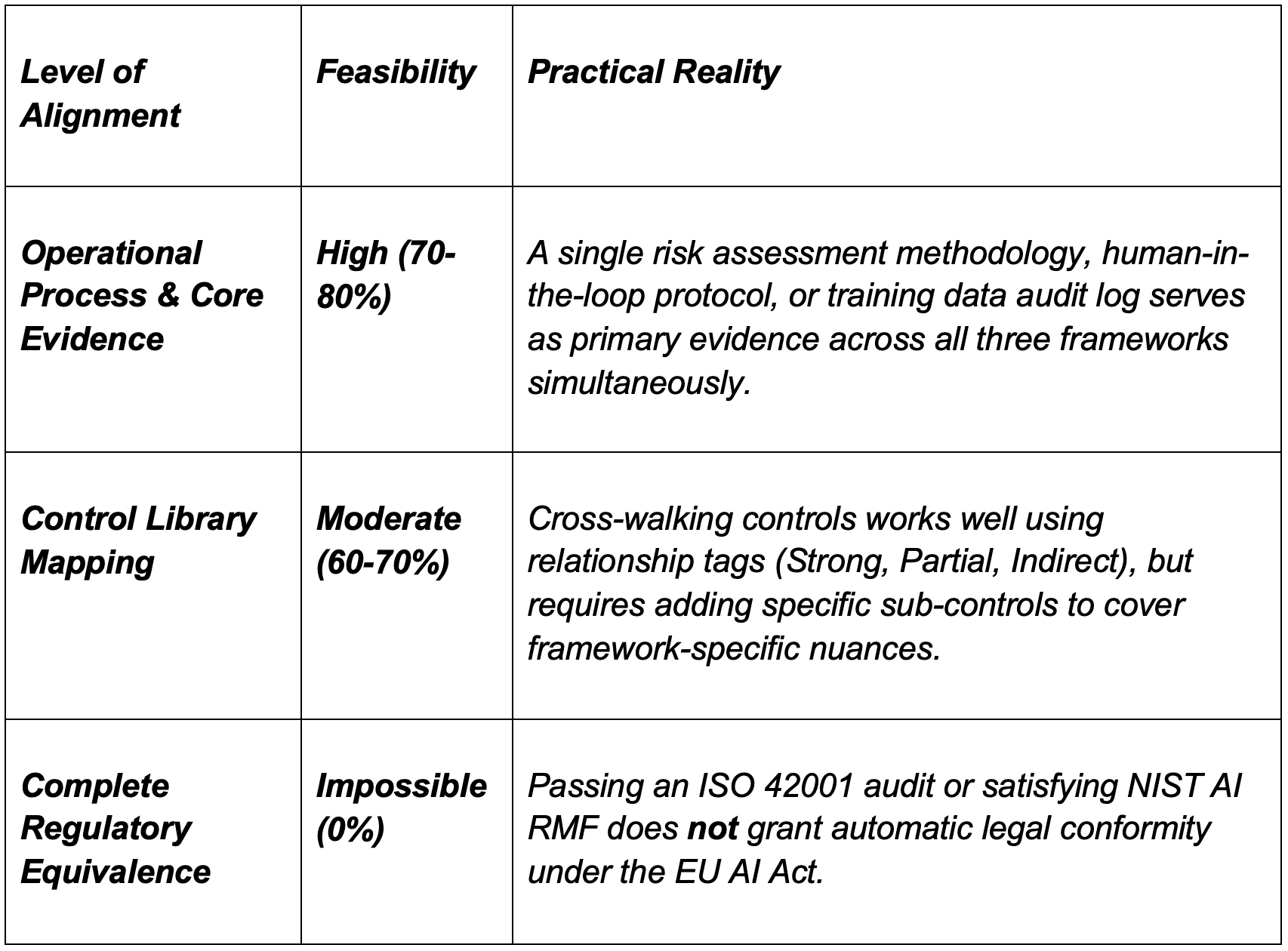
Note: These percentages are my estimate from running crosswalks in practice, not a cited benchmark.
How to Build a Defensible Crosswalk
To make “build once, map thrice” work without raising flags during an audit or regulatory review, structure your architecture using three operational rules:
Write Controls in Your Master Taxonomy: Draft internal controls in your organization’s voice (e.g., “All production models must maintain automated data lineage and input validation logs”). Map your internal master controls outward to NIST, ISO, and EU AI Act requirements, rather than trying to map external framework texts directly to one another.
Account for Partial Mappings: Where an alignment is partial such as ISO requiring general risk treatment while the EU AI Act mandates specific post-market monitoring timelines flag the delta so your team knows additional secondary evidence is required.
Maintain a Dedicated Gap Register: Keep unique, non-transferable legal mandates (like EU CE marking, Notified Body assessments, or EU database registrations) in a separate compliance module so they don’t bloat your daily operational risk engine.
Maintaining the Program
A unified framework is a living program, not a static project.
● Quarterly Reviews: The inventory should be formally reviewed quarterly at minimum to assess completeness (new systems added?), accuracy (details current?), and compliance posture (systems operating within approved risk parameters?).
● Single Ownership: Establish clear ownership for the AI inventory under the CAIO, CISO, or Chief Compliance Officer. The owner must possess the authority to compel disclosure across business units and the technical credibility to engage engineering teams.
● Cross-Functional Governance: IT/Engineering provides technical discovery, Procurement flags new AI acquisitions, Legal classifies regulatory scope, and Business Leaders track team tools.
The Bottom Line
Running frameworks in silos produces three inconsistent inventories and collects the same evidence three times. Teams treating each framework as its own spreadsheet do triple the work for the same outcome. Teams running one control library mapped across all three collect each piece of evidence once.
Start with NIST as your operational engine, ISO 42001 as your certifiable management system, and the EU AI Act as your legal requirement layer. Build once, map thrice, and evidence once.
How many AI system inventories does your organization currently maintain? What was the biggest blind spot or ungoverned AI tool discovered in your catalog this year?
Coming Soon: Enclave-AI and Enclave-SSP
I built Enclave-AI because most AI governance tools ask you to translate framework language into your own controls by hand. It ships with NIST AI RMF, the EU AI Act, Colorado SB 205, and NYC Local Law 144 and more built in, organized by framework so you can see exactly which controls apply and track assessment status per sub-control.
Enclave-SSP handles the other side of the compliance workload: building and maintaining System Security Plans without the spreadsheet sprawl.
Both are part of the Enclave Compliance Suite, launching soon.