


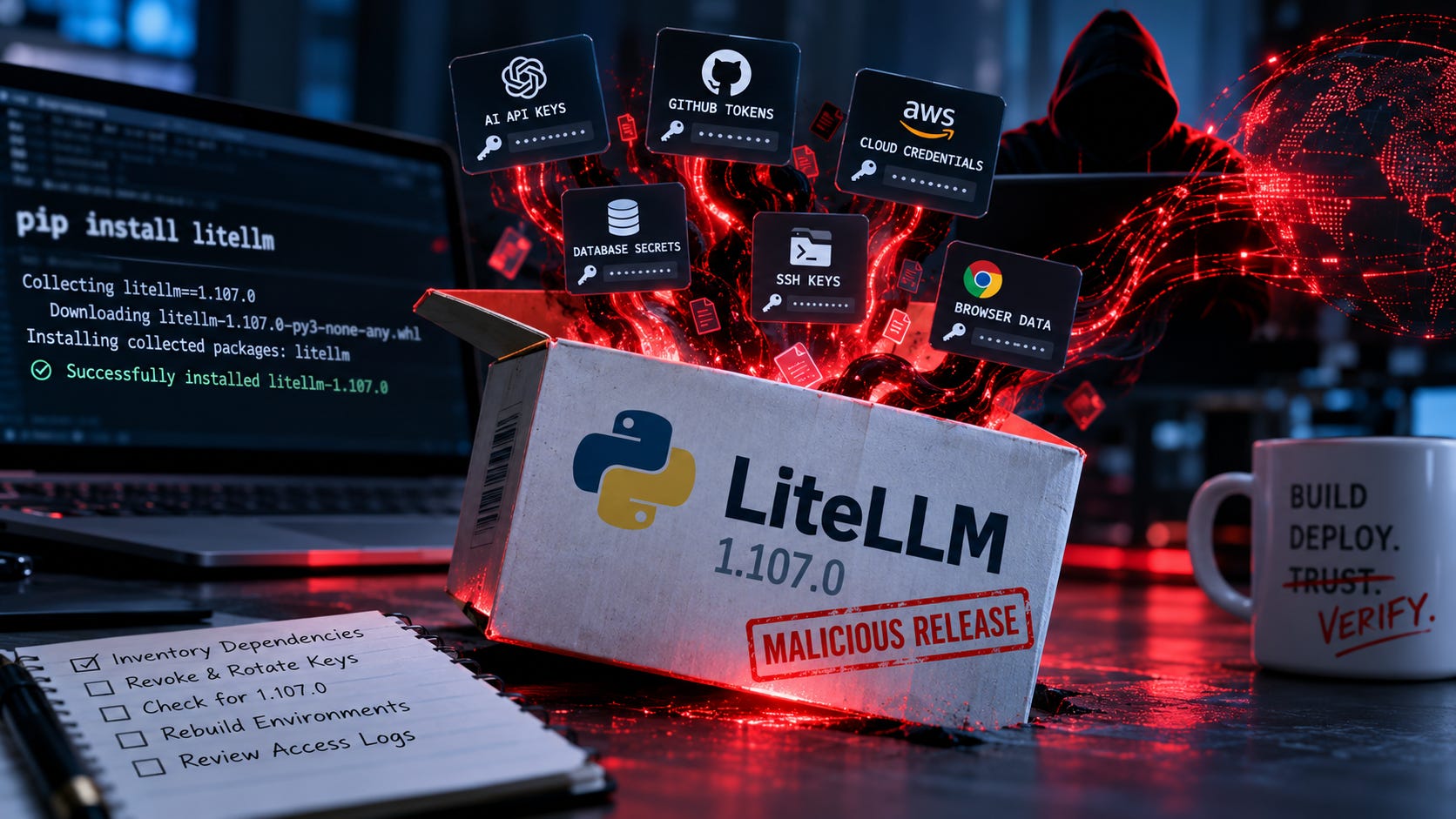
The Trusted Update That Became the Threat
Imagine installing a routine software update, only to discover that the software intended to connect your applications to artificial intelligence services was quietly collecting your credentials.
Your cloud access tokens. Your GitHub authentication credentials. Your SSH keys. Even credentials associated with your AI development tools.
On October 21, 2026, that scenario became a real security incident when attackers compromised the release infrastructure behind LiteLLM, a widely used open-source library and gateway for connecting applications to large language models.
The malicious version, litellm==1.107.0, was distributed through the Python Package Index (PyPI) and official container registries. Although the affected release was removed within hours, its potential impact extended well beyond the AI gateway itself.
This was not merely a malicious library waiting for an application to execute its functions. The attackers exploited Python startup behavior, allowing the malware to execute whenever Python initialized within an affected environment.
For cybersecurity teams, the incident raises immediate concerns about credential exposure. For GRC professionals, it presents a deeper question: How trustworthy are software supply chain controls when legitimate release workflows can be redirected by stolen identities?
And for anyone building or deploying AI applications, it illustrates why API keys and developer credentials must be treated as valuable security assets.
What Is LiteLLM, and Why Does It Matter?
LiteLLM provides a common interface for interacting with multiple AI model providers.
Rather than developing separate integrations for services such as OpenAI, Anthropic, and other model platforms, developers can use LiteLLM to simplify API connections, routing, authentication, and model management.
In enterprise environments, LiteLLM can function as a centralized AI gateway, coordinating requests among applications and external AI providers.
That convenience also makes it a sensitive component.
Depending on its configuration, an AI gateway may have access to provider API keys, database credentials, environment variables, and cloud identities. It may also operate inside development environments that contain additional secrets unrelated to the gateway.
Consequently, compromising the software supplying that gateway can expose far more than model access.
How the Attack Unfolded
According to LiteLLM’s October 23 investigation, the compromise began months before the malicious release appeared.
On May 27, 2026, a configuration file containing a master key for an experimental LiteLLM Agent Platform deployment was inadvertently committed to a public GitHub repository. Although the exposed material was identified, the master key was not revoked.
On October 10, an attacker used that credential to access the Agent Platform and obtain a GitHub CLI OAuth token associated with an organization owner.
This token provided powerful repository permissions. The attackers subsequently acquired additional developer credentials and used them to manipulate the release process.
The critical step involved redirecting LiteLLM’s legitimate release workflow toward an attacker-controlled repository named Berri-AI/litellm, rather than the legitimate BerriAI/litellm.
The difference was only a hyphen.
The attackers then used compromised developer identities to trigger and approve the release.
On October 21, malicious software was published through LiteLLM’s official distribution channels.
The compromised PyPI version was available from approximately 11:39 UTC to 13:23 UTC. Affected Docker Hub images remained available through the compromised image index until approximately 14:20 UTC.
This was especially concerning because the published artifacts appeared to originate from legitimate infrastructure. The official GitHub source tag did not contain the malicious files.
The trust failure occurred in the relationship between the approved source, the build process, and the artifacts ultimately delivered to users.
The Malware Did Not Need an AI Prompt to Execute
Security researchers identified three malicious files introduced into the Python installation:
cook.pth, cook.py, and sitecustomize.py.
These files exploited Python’s interpreter initialization mechanisms.
Normally, developers think of malicious library code as something that executes when an application imports or invokes a compromised package.
Here, the attack was more invasive.
A Python startup configuration file could activate the credential collector automatically. Another component provided a mechanism for retrieving and executing additional code on Unix-based systems.
That means an unrelated Python application running inside the compromised environment could trigger malicious execution.
Researchers found that the credential collector targeted information including cloud provider credentials, GitHub and other developer tokens, SSH keys, browser data, AI coding assistant sessions, environment variables, and LiteLLM proxy database records.
Collected information could then be encrypted and transmitted to attacker-controlled infrastructure.
Microsoft confirmed endpoint behavior consistent with the collector’s credential discovery and outbound communication. Researchers also identified a remote code execution mechanism, although they did not confirm that its additional payload was deployed in the wild.
The distinction matters. The credential theft mechanism was demonstrated, but not every possible subsequent action should be described as an observed compromise.
The Hidden Danger: AI Credentials Are Connected to Other Systems
An AI API key is often treated as a simple application configuration value.
In reality, its permissions and surrounding environment determine the potential damage.
Consider an AI development workstation connected to a GitHub repository, cloud infrastructure, an internal database, and several AI model providers.
If that workstation executes credential-stealing malware, the exposure may extend across all those resources.
Stolen API credentials may allow unauthorized model usage and financial charges. Depending on the provider, token permissions, and architecture, they could also provide access to stored application resources or sensitive data.
Compromised developer credentials could permit repository access, software modifications, or additional supply chain attacks.
Cloud credentials may have still broader implications.
Importantly, possessing an AI provider key does not automatically provide access to every conversation, prompt, or dataset associated with an account. Those risks depend on the particular permissions and services involved.
The correct security question is therefore not simply whether an API key was stolen.
It is: What could the compromised identity access, and what other systems trusted that identity?
Why This Is a GRC Problem, Not Just a Malware Incident
The LiteLLM incident demonstrates how multiple security controls can fail together.
The original exposed credential was identified but not revoked. A highly privileged developer token was accessible through an experimental platform. Release safeguards were modified, and compromised identities were ultimately used to approve a malicious artifact.
For governance teams, this creates several important lessons.
First, credential exposure requires lifecycle management. Identifying an exposed secret is not the same as containing the risk. Revocation, rotation, and verification must be part of the incident response process.
Second, release approval must be more than an identity check. Multiple approvals offer limited protection when an attacker controls multiple authorized identities. Release systems should enforce independent controls over which source repositories and commits can be built.
Third, software provenance needs meaningful validation. A signed artifact or trusted publishing workflow is not sufficient if the workflow builds from an unauthorized source.
Fourth, AI infrastructure belongs within the organization’s software supply chain risk program. AI gateways, coding assistants, orchestration frameworks, and their dependencies should be inventoried, monitored, and assessed like other production software.
Several established frameworks can help organizations turn these lessons into operational controls.
The NIST Cybersecurity Framework 2.0 emphasizes governance, supply chain risk management, identity management, detection, and incident response.
NIST’s Secure Software Development Framework provides practices for protecting development environments and software releases.
ISO/IEC 27001 supports information security management, while ISO/IEC 42001 addresses the governance and management of AI systems.
None of these frameworks automatically prevents a LiteLLM-style compromise. Their value depends on whether documented requirements are translated into effective technical safeguards and verified evidence.
What Security Teams Should Do Now
Organizations should begin by determining whether affected LiteLLM packages or container images entered their environments.
The confirmed affected Python package was litellm==1.107.0. Affected container tags included v1.107.0, latest, main-latest, and main-stable during the incident window.
The following actions provide a practical response strategy.
1. Identify potentially affected systems.
Review software inventories, dependency lockfiles, software bills of materials (SBOMs), CI/CD records, container digests, and deployment histories.
Include developer laptops, build agents, test environments, and production servers.
2. Avoid executing Python in a suspected compromised environment.
Because the malware used Python startup mechanisms, even running pip inside the affected environment may activate it again.
Use trusted administrative tools, offline inspection, or a clean investigation environment to inspect affected systems.
3. Rebuild compromised environments.
LiteLLM recommended returning to a verified preincident release, including version 1.106.2, as an immediate containment measure.
Rebuilding virtual environments and container images from verified sources is preferable to assuming that uninstalling the package removes all malicious files.
4. Revoke and rotate potentially exposed credentials.
Prioritize provider API keys, GitHub tokens, cloud identities, SSH credentials, database passwords, LiteLLM master and virtual keys, and other secrets accessible to the compromised environment.
Rotation should occur from a trusted system.
5. Investigate possible credential misuse.
Review cloud audit events, unusual API activity, repository access, unexpected authentication attempts, and suspicious outbound network connections.
Absence of a known malware artifact does not establish that no exfiltration occurred.
6. Strengthen release and dependency controls.
Pin dependency versions and container image digests, verify build provenance, restrict production publishing privileges, and require controlled approval of release source changes.
Automated security checks should inspect distributed artifacts, not merely the source repository.
These actions reduce both immediate exposure and the likelihood of a similar compromise going undetected.
The Larger Lesson: Trust Must Be Continuously Verified
The LiteLLM compromise is particularly revealing because attackers did not have to persuade thousands of developers to visit a malicious website.
They compromised a legitimate delivery mechanism that developers already trusted.
An overlooked credential provided an entry point. Privileged tokens enabled lateral movement. A release workflow was redirected, and credential-stealing software reached users through familiar installation channels.
The incident also highlights a growing challenge in AI governance: organizations may carefully review models, prompts, and AI usage policies while overlooking the infrastructure and developer identities that make those systems work.
AI security does not begin or end with model behavior.
It includes dependency integrity, privileged access, secrets management, build provenance, runtime monitoring, and the ability to determine exactly what a compromised system could reach.
The most valuable response is not abandoning AI tools. It is applying mature cybersecurity engineering practices to the increasingly complex infrastructure supporting them.
The Question We Should Be Asking
When an organization approves an AI platform or development tool, are its governance controls focused primarily on what the AI produces, or do they also verify the credentials, dependencies, and software pipelines that make the AI possible?
If a trusted AI dependency were compromised tomorrow, could your organization identify every affected environment, determine which credentials were exposed, and revoke them before attackers moved deeper into your infrastructure?
Sources and Further Reading
Research reviewed October 24, 2026. Findings reflect currently published incident reports and may change as additional evidence becomes available.