



Imagine an AI system recommending whether someone qualifies for a loan, receives a job interview, or gets flagged for additional scrutiny.
A human reviewer examines the recommendation and clicks “Approve.”
The organization records the approval. Its compliance dashboard turns green. Management reports that every AI decision receives human oversight.
But what actually happened?
Did the reviewer examine the supporting evidence? Understand the model’s limitations? Consider alternative explanations? Or simply click a button?
A human approval is not necessarily proof of human judgment.
As organizations deploy AI in increasingly consequential decisions, the distinction between recorded oversight and meaningful oversight is becoming a fundamental governance challenge.
Article 14: Human Oversight Must Be Meaningful
Article 14 of the European Union’s Artificial Intelligence Act, Regulation (EU) 2024/1689, establishes human oversight requirements for high risk AI systems.
The provision emphasizes the ability of human overseers to understand system capabilities and limitations, recognize automation bias, interpret outputs, disregard or override recommendations, and intervene when necessary.
Article 26 complements these requirements by addressing deployer responsibilities, including selecting oversight personnel with appropriate competence, training, authority, and support.
However, regulatory timing matters.
Under the AI Act as amended by Regulation (EU) 2026/1744, the principal high risk requirements generally apply from:
December 2, 2027: High risk AI systems classified under Article 6(2) and Annex III, including specified applications in employment, education, and creditworthiness assessment.
August 2, 2028: High risk systems classified under Article 6(1) and Annex I, involving certain regulated products.
Transitional provisions may affect particular existing systems. Other AI Act obligations have already become applicable.
These dates provide preparation time, not a reason to postpone implementation.
Organizations need time to engineer human review workflows, implement logging capabilities, establish accountability, and validate whether oversight mechanisms actually work.
The central question is straightforward:
Can your organization demonstrate that human oversight is effective, rather than merely documented?
Six Metrics That Make Human Oversight Measurable
Organizations routinely collect AI telemetry, including system errors, model performance, and response times.
Human oversight deserves comparable attention.
The following metrics are proposed internal governance indicators, not legally prescribed numerical benchmarks under Article 14.
No universal regulatory threshold establishes an acceptable override percentage, review duration, or rejection rate. Each metric requires interpretation within its operational context.
1. Intervention Latency
What it measures: The elapsed time between an AI recommendation becoming available for review and a consequential human action.
Suppose a reviewer receives a recommendation at 10:00:00 and acts at 10:00:45. The recorded latency is 45 seconds.
Extremely short review times could indicate superficial approval behavior, particularly when complex evidence requires examination.
However, speed does not automatically indicate inadequate oversight.
A straightforward decision may legitimately require less attention than a complicated one. Latency should therefore be evaluated alongside case complexity, evidence engagement, and decision outcomes.
2. Override Frequency
What it measures: The percentage of reviewed AI recommendations modified or reversed by human reviewers.
Formula:
Override Rate = (Overridden Recommendations / Reviewed Recommendations) × 100
A low override rate might indicate excellent model performance.
It could also indicate automation bias, inadequate reviewer independence, or organizational pressure to accept automated recommendations.
A high override rate might reveal poor model performance or effective identification of problematic recommendations.
The percentage alone cannot explain the difference.
3. Rejection Rate
What it measures: The percentage of reviewed AI recommendations rejected rather than accepted or modified.
Formula:
Rejection Rate = (Rejected Recommendations / Reviewed Recommendations) × 100
For example, a fraud investigator might reject an automated alert after examining transaction records and identifying a legitimate explanation.
Tracking rejection reasons can reveal recurring model weaknesses, misleading inputs, or deficiencies in operational procedures.
4. Evidence Engagement Rate
What it measures: The percentage of decisions in which reviewers access designated supporting evidence.
Organizations can record whether reviewers examine source documents, explanations, uncertainty indicators, or contradictory information.
This creates additional evidence beyond an approval timestamp.
However, opening a document does not prove understanding. Evidence access telemetry must be complemented by decision quality assessments.
5. Escalation and Intervention Effectiveness
What it measures: Whether reviewers escalate cases requiring additional scrutiny and whether intervention mechanisms function correctly.
Useful indicators include escalation frequency, unresolved escalation age, successful override execution, and failed intervention attempts.
An interface that displays a stop button but cannot reliably interrupt an unsafe operation provides questionable operational control.
Organizations should periodically test intervention capabilities against documented requirements.
6. Error Detection Effectiveness
What it measures: How reliably human reviewers identify incorrect or unsafe AI recommendations during controlled evaluations.
Formula:
Detection Rate = (Known Errors Correctly Identified / Known Errors Presented) × 100
An organization might periodically evaluate reviewers using representative cases containing independently verified AI errors.
Unlike metrics that primarily measure activity, this approach examines whether reviewers can recognize problems requiring intervention.
However, evaluation quality matters. Test cases must be representative, expected outcomes must be reliable, and reviewers should not be encouraged to reject correct recommendations merely to improve their scores.
The objective is accurate independent judgment, not unnecessary intervention.
The Hidden Threat: Rubber Stamping Fatigue
Even well designed oversight policies can fail when operational pressures encourage superficial reviews.
Imagine an employee reviewing hundreds of AI recommendations during a shift.
Every recommendation appears in a nearly identical interface. The approval button is prominently displayed. Performance expectations reward speed.
Over time, accepting recommendations may become almost automatic.
This is where AI governance intersects with human factors engineering.
The UK’s Information Commissioner’s Office (ICO), in its Data Protection Audit Framework: Artificial Intelligence Toolkit, Human Review, emphasizes appropriately trained reviewers, manageable workloads, documented procedures, and meaningful opportunities to challenge automated decisions.
Organizations should design interfaces that:
Present supporting evidence and relevant uncertainty clearly.
Make modification, rejection, and escalation practical.
Give reviewers sufficient authority and time to challenge recommendations.
Avoid default approval patterns that encourage reflexive acceptance.
Test whether reviewers can identify incorrect recommendations.
These controls should remain proportionate. Adding unnecessary clicks or mandatory explanations to every routine action can create additional fatigue without improving oversight.
Good interface design should support independent judgment, not merely accelerate approval.
Logging the Human Decision Path
Meaningful oversight also requires defensible audit evidence.
Article 12 establishes logging capabilities for high risk AI systems, while Article 26 addresses deployer responsibilities concerning relevant automatically generated logs.
Organizations can extend their logging architecture to capture human oversight activities.
A practical decision record could include:
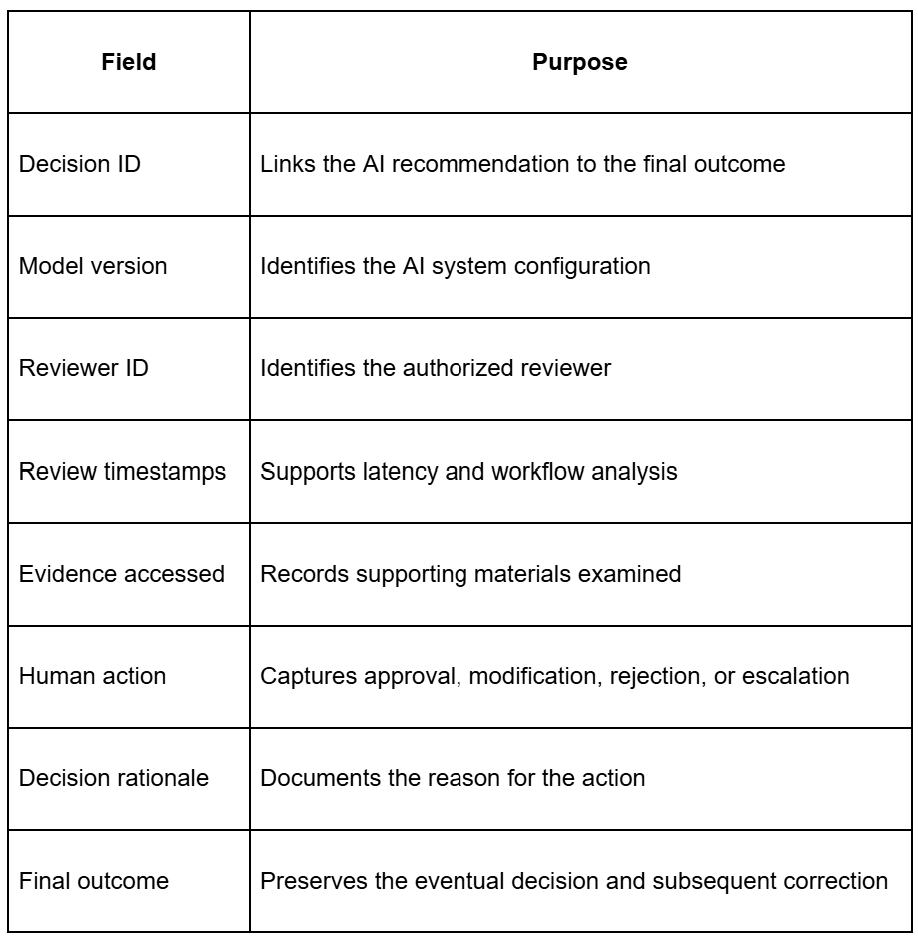
These proposed fields go beyond merely reproducing statutory logging requirements.
Records should incorporate appropriate access controls, integrity protections, retention schedules, and privacy safeguards.
Logging must not become unrestricted employee surveillance.
Most importantly, an audit trail can demonstrate recorded actions without proving the quality of human reasoning.
Independent reviews remain essential.
From Compliance Documentation to Operational Assurance
The NIST AI Risk Management Framework supports a more systematic approach through its GOVERN, MEASURE, and MANAGE functions.
Its MEASURE guidance encourages organizations to examine human AI interactions, including situations where people overrule AI outputs.
NIST’s March 2026 publication, AI 800-4: Challenges to the Monitoring of Deployed AI Systems, reinforces this perspective by identifying human factors monitoring as an important category of post-deployment evaluation.
The report also highlights challenges involving human AI feedback loops, fragmented logging, and scaling human driven monitoring.
For GRC teams, these findings suggest a practical progression.
Define meaningful human oversight requirements. Collect relevant operational metrics. Evaluate reviewer effectiveness. Investigate unusual patterns. Then use those findings to improve training, interfaces, models, and governance procedures.
The goal is continuous operational assurance rather than a one time compliance demonstration.
Accountability Requires More Than a Human Signature
Human oversight should never become a ceremonial final step in an otherwise automated decision process.
An approval button does not guarantee independent judgment. A low override rate does not automatically demonstrate effective AI performance. And a complete audit trail does not establish that every decision was appropriate.
Effective accountability requires combining quantitative telemetry, qualitative assessment, meaningful human authority, and independent evaluation.
The objective is not to maximize human intervention.
It is to ensure that humans can recognize when intervention is necessary, exercise that authority, and provide evidence that the oversight process functions as intended.
Here’s my question for readers:
If an auditor asked your organization to prove that a human meaningfully reviewed, challenged, or corrected an AI generated decision, could you produce the evidence, or would you only have an approval timestamp?
References
These primary and authoritative sources support the article.
EU AI Act, Article 14: Human Oversight. Defines the required oversight capabilities.
EU AI Act, Article 12: Record-Keeping. Establishes automatic logging requirements for high-risk systems.
EU AI Act, Article 26: Deployer Obligations. Addresses personnel competence, oversight, operational monitoring, and log retention.
NIST AI Risk Management Framework. Provides a foundation for measuring and managing AI risks.
ICO: Human Review Audit Guidance. Recommends documenting overrides, reviewer rationale, and workload controls.
NIST, March 2026: Challenges to Monitoring Deployed AI Systems. Discusses operational monitoring, including human factors.
Editorial verification notes
Regulatory timing: As of October 28, 2026, the EU’s published implementation timetable indicates that the high risk requirements for Annex III systems will apply from December 2, 2027, while those for high risk AI embedded in regulated products will apply from August 2, 2028. This distinction matters if presenting Article 14 as an existing enforceable obligation for every high risk system.
AI Act Service Desk
Metrics: The five proposed measures are defensible operational recommendations, but no universal regulatory thresholds or proven performance benchmarks have been established for them in the sources reviewed.
https://youtu.be/GV1TS0HkBJE?si=_ufRtoBRxqbacOdG
The metrics angle is the right pressure point: latency and override rates measure the reviewer's behavior, while the harder question is whether the review queue was designed so attention survives volume. Blanket approval queues degrade into click-through at production scale, which is why tiering review by consequence and reversibility concentrates judgment where an override actually means something. This piece works through the same degradation problem from the system-design side: https://seldondance.substack.com/p/the-tiered-system-real-time-humanagent