


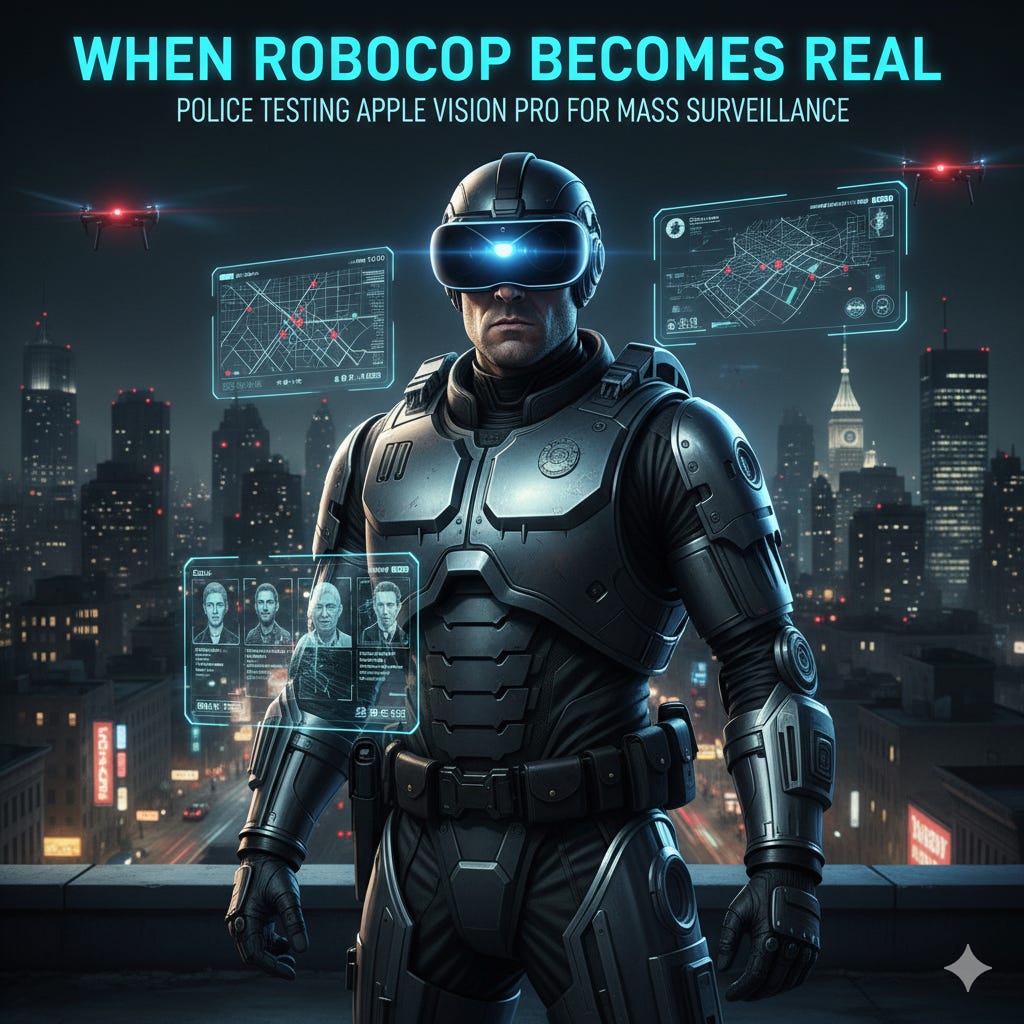
Imagine walking down the street, going about your day. Somewhere nearby, a police officer puts on what looks like ski goggles. Suddenly, they can see live feeds from security cameras across the city, your license plate data, criminal records, and social media profiles, all floating in their field of vision like something out of Minority Report.
This isn’t science fiction. It’s happening right now in California.
Why This Matters More Than You Think
The Orange County Sheriff’s Department and Los Angeles Police Department are actively testing Apple Vision Pro headsets to transform how police conduct surveillance. While these agencies frame it as improving response times and officer safety, this technology fundamentally changes the relationship between citizens and law enforcement.
Here’s what makes this different from previous surveillance tools: It’s everywhere and invisible.
Traditional police surveillance required officers to be physically present at a command center, staring at banks of monitors. Now, officers can remotely access real time operations centers that gather data from license plate readers, mobile phone locations, and criminal records all through a headset they can wear anywhere.
The technology breaks down the last physical barrier between surveillance operations and daily life. An officer could be standing in a coffee shop, at a park, or in their patrol car, silently monitoring multiple camera feeds, running facial recognition, and cross referencing databases, all while appearing to simply wear a high tech gadget.
☕Want to support my work? Consider buying me a coffee
What Police Are Actually Doing With Vision Pro
Let’s be clear about what law enforcement agencies are testing:
Virtual Command Centers: Orange County’s Chief Information Officer Dave Fontneau demonstrated how the headset allowed him to remotely access a virtual version of the department’s Real Time Operations Center and manage operations from a distance. Officers can now carry an entire surveillance operation in a device that weighs less than two pounds.
Augmented Reality Overlays: The LAPD plans to use the device for “enhanced surveillance and monitoring” with augmented reality overlays, providing officers with real time information such as license plate data or live video feed analysis. Imagine looking at someone and instantly seeing their criminal history, outstanding warrants, or social media profiles hovering next to their face.
Hands Free Operations: According to LAPD Deputy Chief John McMahon, the goal is to enable hands free operations so officers can “remain focused on their surroundings and potential threats while still accessing critical data and resources.”
Integration with Broader Surveillance Networks: Orange County runs a program called “Connect Orange County” where residents and businesses can register their security cameras or even give police direct access to live camera feeds. Vision Pro can tap into these networks instantly.
What makes this particularly concerning is how it combines multiple surveillance technologies into one seamless interface. It’s not just one camera, it’s potentially hundreds of cameras, license plate readers, facial recognition systems, and databases, all accessible simultaneously through one device.
The Constitutional Crisis We’re Walking Into
Here’s where things get legally murky and deeply troubling.
The Fourth Amendment protects Americans from unreasonable searches and seizures. But the Supreme Court’s rulings on surveillance technology haven’t kept pace with innovation. The current legal framework leaves dangerous gaps that Vision Pro enabled policing could drive straight through.
The Plain View Doctrine Problem: Courts have long held that police don’t need a warrant to observe things in “plain view”, what any person could see from a public place. But Vision Pro fundamentally changes what counts as “plain view.” Is it still plain view when an officer uses augmented reality to identify you through facial recognition, pull up your license plate records, and see your criminal history all in seconds?
The Third Party Doctrine Loophole: When residents give police permission to access their security cameras, courts have generally ruled this doesn’t violate the Fourth Amendment because the camera owner consented. But does your neighbor’s consent to share their doorbell camera footage mean police can use Vision Pro to conduct warrantless surveillance of your comings and goings?
The Carpenter Precedent: In 2018, the Supreme Court ruled in Carpenter v. United States that police must obtain a warrant before accessing historical cell phone location data because it creates a comprehensive chronicle of a person’s movements and reveals intimate details about their life. The Court recognized that such information is “deeply revealing” due to its “depth, breadth, and comprehensive reach, and the inescapable and automatic nature of its collection”.
Vision Pro surveillance poses the exact same concerns arguably worse. When police can access multiple camera feeds, license plate readers, and databases simultaneously through a headset they can use anywhere, they create that same “comprehensive chronicle” of people’s movements and activities. The difference? They’re doing it in real time, not retrospectively.
Yet there’s no warrant requirement. No judicial oversight. No clear legal framework at all.
The Jones GPS Tracking Paradox: In United States v. Jones (2012), the Supreme Court ruled that prolonged GPS tracking of someone’s vehicle violated the Fourth Amendment. But if police can use Vision Pro to monitor someone through a network of cameras across a city for hours or days, is that functionally different from GPS tracking? Current case law suggests they might not need a warrant, even though the intrusion into privacy is arguably greater.
The fundamental problem: Our constitutional protections were designed for a world where police surveillance required physical presence and obvious action. Vision Pro makes surveillance invisible, omnipresent, and effortless.
Apple’s Quiet Cultivation of the Police Market
Here’s something Apple hasn’t been advertising in its sleek product launches: the company has been hosting secretive “Global Police Summit” conferences at Apple Park, bringing together police departments from seven countries to teach them how to better use Apple products for surveillance work.
According to emails obtained by Forbes, these summits featured presentations on “CarPlay, Crash Detection, Emergency SOS via Satellite, Vision Pro and more,” with law enforcement agencies sharing their “successes, innovations, and lessons learned”.
Matthew Guariglia, an analyst at the Electronic Frontier Foundation, told Forbes that Apple has kept these meetings quiet because “they want to get the reputation that they protect users’ data and they will do so at the expense of their relationship with law enforcement, and at the same time recognizing that creating tech for law enforcement is a multi-billion dollar industry”.
This is the same Apple that ran “What happens on your iPhone, stays on your iPhone” ad campaigns. The same Apple that refused to help the FBI unlock a terrorist’s phone in 2015, citing privacy principles.
The contradiction isn’t necessarily hypocrisy, Apple can both protect encryption and sell products to police. But it does reveal an uncomfortable truth: Privacy protection and surveillance capability can coexist in the same device. The question is who controls it and under what rules.
How to Protect Yourself (Realistically)
I won’t sugarcoat this: There’s no magic shield against Vision Pro surveillance. If police are using this technology with access to public and consensually shared private cameras, there’s no practical way to become invisible. But you can reduce your exposure and protect your rights.
1. Know Your Camera Landscape
Identify security cameras in your neighborhood on homes, businesses, streetlights, and traffic signals
Check if your city has a camera registry program like Orange County’s “Connect OC”
Remember: If you can see a camera, it can potentially see you
2. Understand Camera Consent Programs
Research whether your local police department has a voluntary camera sharing program
If your neighbors have Ring doorbells or other connected cameras, know that police may request footage
Consider whether having such cameras yourself is worth the tradeoff of contributing to the surveillance infrastructure
3. Limit Your Digital Footprint
Reduce social media presence, especially geolocation data and tagged photos
Use privacy settings rigorously though remember that determined law enforcement can often access this data anyway
Be aware that license plate readers are tracking your vehicle movements in many cities
4. Exercise Your Rights During Encounters
If stopped by police, you have the right to remain silent
You can ask if you’re free to leave; if yes, leave calmly
You can refuse consent to search (though police may search anyway if they claim other legal grounds)
Request to see any warrant before allowing searches of your property or devices
Document encounters when safe to do so
5. Secure Your Devices
Use strong passcodes (not biometrics like Face ID, which police can compel you to use)
Enable full disk encryption on your devices
Be aware of what data your apps collect and share
Consider that any data stored in “the cloud” may be accessible to law enforcement through service provider cooperation
6. Support Privacy Protective Policies
Learn about your city’s surveillance policies (or lack thereof)
Attend city council meetings where surveillance technology purchases are discussed
Support organizations like the ACLU and Electronic Frontier Foundation that fight for digital privacy rights
Vote for representatives who prioritize privacy protections
7. The Most Practical Advice: Act Like You’re Always Being Watched
This is depressing but realistic: In areas with heavy camera coverage and if police deploy Vision Pro surveillance widely, assume any public space could be monitored. This doesn’t mean living in fear, it means being thoughtful about where you go, what you say in public, and what digital traces you leave.
What We Should Demand From Our Government
The technology is here. Police are testing it. The constitutional framework is decades behind. We can’t uninvent Apple Vision Pro, but we can demand democratic control over how it’s used.
Require Warrants: Any use of Vision Pro or similar technology to actively monitor individuals or track their movements should require a warrant based on probable cause just like Carpenter required for cell phone location data.
Mandate Transparency: Police departments should be required to publicly disclose what surveillance technologies they’re testing and deploying, with community input before adoption.
Create Use Policies: Clear rules about when, where, and how Vision Pro surveillance can be used, with strict prohibitions on dragnet monitoring.
Establish Oversight: Independent civilian review boards should audit surveillance technology use, with the power to discipline violations.
Sunset Provisions: Surveillance technology authorizations should expire after set periods, requiring renewed justification and public approval.
Data Retention Limits: Strict rules about how long surveillance data can be stored and who can access it, with regular audits.
The Question That Defines Our Future
Technology moves faster than law. Innovation outpaces regulation. Companies build tools with remarkable capabilities and leave society to figure out the rules afterward.
Apple Vision Pro is just the beginning. Every year, surveillance technology becomes more powerful, more seamless, more invisible. Today it’s a headset that lets police access multiple camera feeds. Tomorrow it might be AI that automatically flags “suspicious behavior.” Next year it could be predictive policing that identifies “potential criminals” before any crime occurs.
The question isn’t whether technology can do something it’s whether we’ll allow it to, and under what conditions.
We’re at a pivotal moment. The choices we make now about surveillance technology will determine what kind of society we live in for decades to come. Will we live in a world where stepping outside means being continuously monitored, cataloged, and analyzed? Or will we demand that our constitutional right to privacy evolves alongside technology?
The police departments testing Vision Pro aren’t asking these questions. Apple isn’t asking these questions (at least not publicly). So we must.
Take Action Today
This isn’t a problem we can fix alone, but collective action matters:
Research your local police department: File Freedom of Information Act (FOIA) requests asking what surveillance technologies they’re testing or deploying. You have the right to this information.
Contact your elected representatives: City council members, state legislators, and members of Congress need to hear that constituents care about surveillance oversight. Be specific: mention Vision Pro and real time surveillance technology.
Support digital rights organizations: Groups like the Electronic Frontier Foundation, ACLU, and local digital rights organizations fight these battles in courts and legislatures. They need resources to continue.
Stay informed: This technology is evolving rapidly. Follow journalists and organizations that cover surveillance technology. Share what you learn.
Start local conversations: Bring this up at neighborhood meetings, with friends, with family. Democracy requires an informed citizenry.
The technology to surveil everyone, everywhere, all the time now fits in a sleek headset. Whether that technology gets used that way isn’t inevitable, it’s a choice.
Let’s make sure we have a say in that choice.
Have you seen surveillance technology being used in your community? Have you filed FOIA requests or attended city council meetings about police surveillance? Share your experiences in the comments. The more we share information, the more informed we all become.
If you found this article valuable, please share it with others. These issues affect everyone, but they only get discussed when people like you bring them into the conversation.