


Imagine a financial services company discovering that its AI powered loan assessment system has been making questionable recommendations for three months.
An internal investigation begins. The compliance officer asks which model version produced the affected recommendations. The security team wants to know whether the underlying model was modified. Auditors request the system prompts, risk evaluations, and approval records associated with the deployment.
The development team has an uncomfortable answer.
They know which application was running, but the system prompt has been edited repeatedly, the model was updated through a third party API, and nobody preserved the exact configuration used when the decisions occurred.
There is no reliable way to reconstruct what happened.
This scenario is hypothetical, but it illustrates a governance weakness that becomes more consequential as organizations place AI into production.
We have spent decades learning to track changes to software. Now we need to apply that discipline to the AI systems influencing our decisions.
The Hidden Components of an AI System
Traditional software development relies on version control systems such as Git to track source code, configuration files, and documentation.
Developers can identify who modified a component, review changes, restore previous versions, and associate releases with testing results.
AI introduces additional components that can alter system behavior without changing conventional application code.
These include system prompts, model weights, fine tuning configurations, retrieval data, safety policies, model routing rules, and inference parameters.
Consider an AI customer service assistant.
Changing its system prompt from “provide general account information” to “assist customers with account modifications” could significantly expand its expected behavior.
Yet that change might never trigger a traditional security review.
Similarly, updating model weights or switching to a newer hosted model can alter outputs even when the surrounding application remains untouched.
The compliance challenge is straightforward:
If an organization cannot identify the exact AI components operating at a particular moment, how can it demonstrate that the system was properly evaluated and authorized?
What NIST AI RMF Tells Us
The NIST AI Risk Management Framework provides a useful foundation for addressing this problem.
Its four functions, Govern, Map, Measure, and Manage, establish a structured approach to understanding and controlling AI risks.
Two are particularly relevant to AI artifact versioning.
Measure: Evidence Before Assurance
The Measure function focuses on assessing AI systems using appropriate methods, metrics, and testing.
Suppose developers modify a system prompt to reduce hallucinations or prevent unauthorized disclosures.
Testing may demonstrate improvement, but the results have limited long term evidentiary value unless they are associated with the specific configuration evaluated.
An effective record should identify:
The exact system prompt and model version tested.
The datasets and evaluation methodology used.
The results of security, reliability, and performance testing.
The person or process approving the change.
The version subsequently deployed.
This creates traceability between the system being evaluated and the system actually operating in production.
Without that connection, evaluation evidence can become obsolete immediately after a modification.
Manage: Accountability After Deployment
The Manage function concerns prioritizing, responding to, and monitoring identified AI risks.
Imagine a security team discovering that a recent prompt modification weakened protections against prompt injection.
A documented deployment history would help investigators determine when the modification occurred, which releases were affected, and whether the organization can restore a previously approved configuration.
Version control becomes more than an engineering convenience.
It supports incident response, corrective action, change management, and ongoing oversight.
Importantly, NIST AI RMF is a voluntary framework. It does not prescribe Git or cryptographic signatures as mandatory implementation mechanisms.
Those are engineering choices organizations can adopt to produce stronger evidence of their risk management activities.
From Docs-as-Code to AI Governance-as-Code
The cybersecurity industry already has a useful methodology for managing documentation alongside software: docs-as-code.
Policies, technical specifications, and configuration files can be maintained as version controlled artifacts.
The same approach can support AI governance.
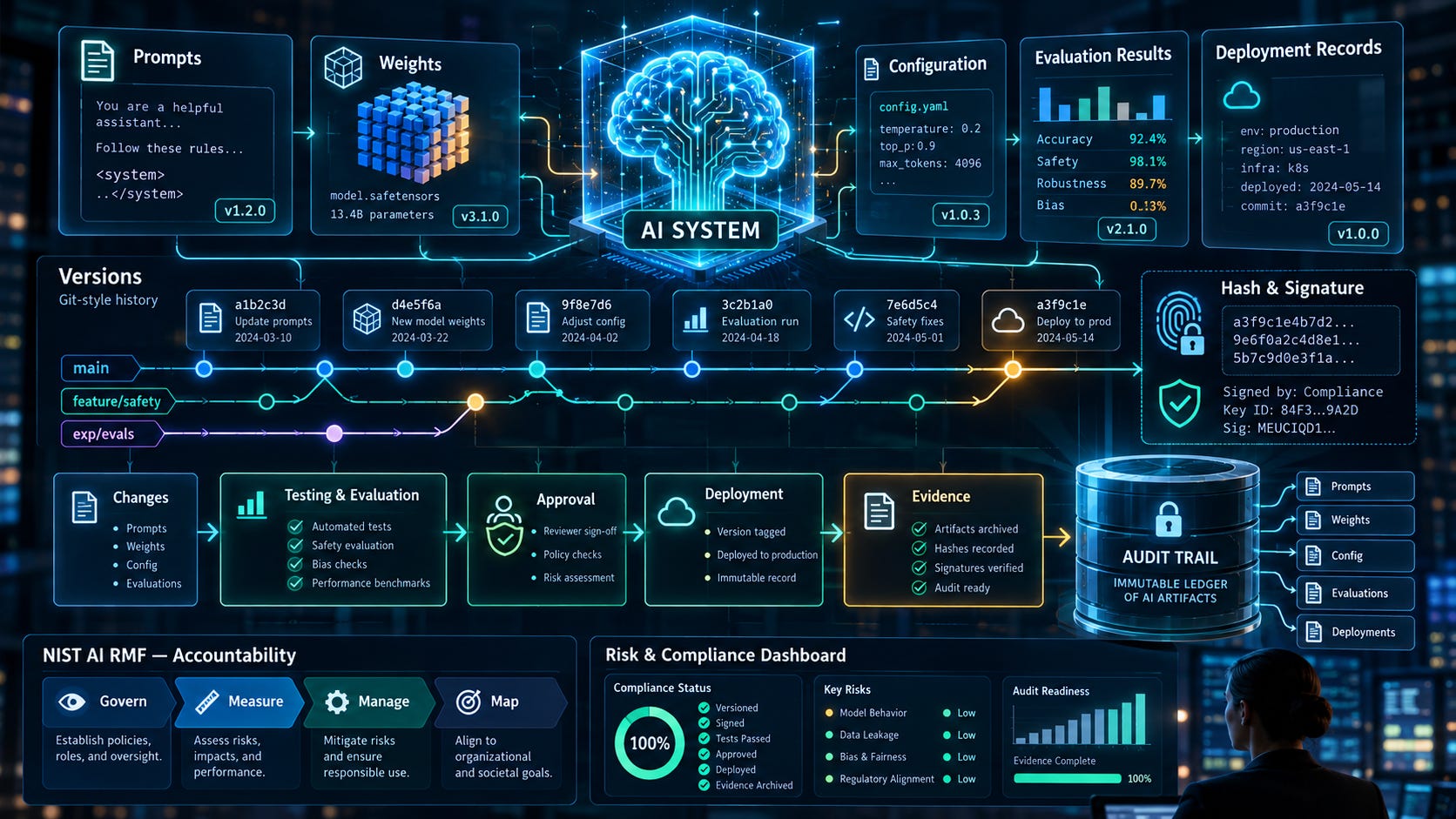
Instead of maintaining system prompts in disconnected documents or administrative interfaces, an organization can manage approved prompts as controlled configuration files.
Each proposed change can pass through a familiar workflow.
A developer submits a change through Git. Automated checks examine formatting, sensitive information exposure, and relevant security rules. An evaluation pipeline tests the proposed prompt against approved scenarios.
Human reviewers examine the change and supporting evidence before deployment.
Once approved, the release is associated with a specific commit, prompt version, model identifier, and evaluation report.
For larger organizations, these records can feed directly into existing GRC evidence repositories.
The goal is not simply to maintain more documentation.
The goal is to make governance evidence a natural output of the engineering process rather than something reconstructed before an audit.
Why Git History Is Not Enough
Git is valuable, but a Git repository is not automatically an immutable, independently trustworthy audit system.
Repository administrators may be able to rewrite history, delete references, or alter access controls.
Furthermore, conventional Git workflows do not automatically prove that the artifacts in a repository were the artifacts actually deployed.
This is where cryptographic controls become important.
A SHA-256 digest can establish a content fingerprint for an artifact, including a model weight file or prompt configuration.
A digital signature can bind an artifact or its digest to a signing identity, allowing another party to verify that it has not changed since signing.
Signed attestations can extend this concept by recording information about how an artifact was produced and evaluated.
The SLSA supply-chain security framework provides a useful model for producing verifiable software provenance.
Similarly, Sigstore’s Cosign supports cryptographic signing and verification of files.
Organizations can adapt these practices to AI artifacts.
However, a signature establishes integrity and signing identity, not model safety or regulatory compliance.
A securely signed but poorly evaluated model remains a poorly evaluated model.
For stronger audit assurance, cryptographic records should be combined with protected storage, trusted timestamps, access controls, retention policies, and independent verification.
Model Weights Require Special Treatment
Prompts are often manageable as ordinary text files.
Model weights present a different challenge.
Large models can contain billions of parameters, creating artifacts that are impractical to store directly in standard Git repositories.
A better approach is to store model files in an appropriate artifact registry or controlled storage system while keeping their identifiers, cryptographic digests, and associated metadata under version control.
For self hosted models, organizations should record the precise model artifact, tokenizer version, quantization method, and relevant runtime configuration.
For hosted AI services, the situation is more complicated.
A vendor may provide a model name without exposing its weights, an immutable revision, or every infrastructure change affecting inference.
Organizations should therefore preserve the exact vendor identifiers and available version information, document contractual limitations, and evaluate whether the provider offers sufficient change notifications and traceability.
They should not claim reproducibility when the underlying model version cannot be independently identified.
This distinction matters because model provenance is not always fully under the customer’s control.
The Regulatory Connection
AI traceability is also becoming increasingly relevant to legal compliance.
The EU AI Act provides a concrete example.
Article 11 establishes technical documentation requirements for high risk AI systems.
Article 12 requires such systems to support automatic event logging throughout their lifecycle, with capabilities appropriate to their intended purpose.
These provisions reinforce the importance of documented system behavior and operational traceability.
They do not, however, create a universal requirement to cryptographically sign every prompt and model weight file.
The applicable obligations depend on the system’s classification, the organization’s role, and the relevant legal provisions and implementation dates.
For GRC professionals, that distinction is essential.
A recommended engineering control should never be misrepresented as an explicit regulatory mandate.
Nevertheless, controlled artifact histories can help organizations support technical documentation, incident investigations, and conformity assessments where applicable.
Building an Audit Ready AI Pipeline
Organizations do not need to develop an entirely new compliance platform to begin improving AI traceability.
They can start by introducing six practical controls.
First, establish an AI artifact inventory. Identify prompts, models, datasets, retrieval indexes, evaluation configurations, and other components that materially affect system behavior.
Second, assign version identifiers. Record precise artifact revisions and cryptographic digests wherever possible. Avoid relying exclusively on mutable labels such as “latest.”
Third, require documented approvals. Significant changes should include an owner, rationale, risk assessment, and authorization appropriate to their potential impact.
Fourth, automate evaluations. Connect proposed AI changes to security and performance tests, retaining the results alongside the versions evaluated.
Fifth, protect the evidence. Use signed release manifests, restricted access, protected or immutable retention mechanisms, and verification procedures suited to the organization’s risk profile.
Sixth, connect deployment telemetry to governance records. Ensure investigators can identify which approved model, prompt, and configuration versions were active when a relevant event occurred.
These controls create a defensible chain from development to approval to deployment.
They also make it easier to identify unauthorized changes and investigate unexpected behavior.
For privacy sensitive systems, audit collection should minimize personal data, protect confidential prompts, and apply appropriate retention and access restrictions.
An audit trail should not become another uncontrolled repository of sensitive information.
The Real Question Is Whether You Can Prove It
AI governance is gradually moving beyond policy declarations toward operational evidence.
Organizations can publish responsible AI principles, establish governance committees, and produce sophisticated risk assessments.
But those efforts lose credibility when nobody can demonstrate which AI components were tested, approved, and deployed.
Version control, cryptographic verification, and protected audit records do not make an AI system trustworthy by themselves.
They make its development and deployment history more accountable, inspectable, and defensible.
And that is an important foundation for trustworthy AI.
If an auditor asked your organization to reconstruct the exact AI system responsible for a consequential decision six months ago, could you produce verifiable evidence, or would you be relying on someone’s memory?