


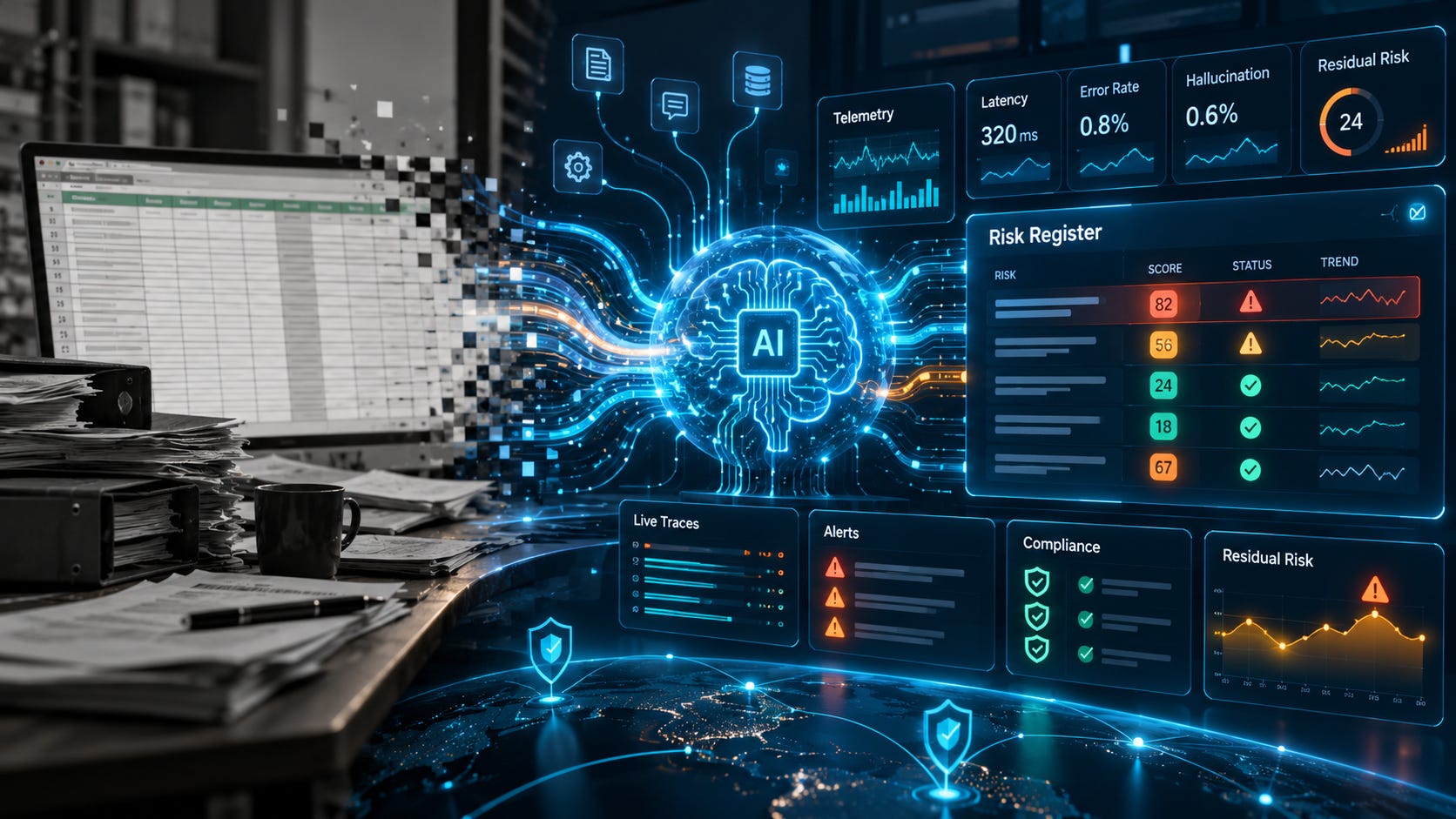
The Risk Register That Never Saw the Problem Coming
Imagine an organization deploying an AI-powered customer service platform. Before launch, the governance team completes its risk assessment, documents potential hallucinations, evaluates security controls, and assigns a residual risk rating of Moderate.
The completed risk register is reviewed, approved, and stored for the next scheduled assessment.
Three months later, an application update changes the model’s behavior. Customers begin receiving incorrect information. Response times deteriorate, and several automated workflows behave unexpectedly.
The engineering team sees the warning signs in its monitoring dashboards. The cybersecurity team receives operational alerts. Yet the governance team’s risk register still reports Moderate risk.
The organization has operational visibility, but its governance records are disconnected from reality.
This scenario is hypothetical, but the underlying problem is real: traditional governance workflows often separate the people assessing risk from the systems generating evidence about it.
When AI systems can change through model updates, revised prompts, new data sources, and expanded integrations, a periodically updated spreadsheet can quickly become an incomplete representation of operational risk.
The solution is not to abandon risk registers. It is to make them living records connected to production evidence.
Why Traditional Risk Registers Struggle with AI
Conventional risk registers document identified threats, likelihood, impact, existing controls, residual risk, and responsible owners.
That structure remains valuable. The problem is how frequently the underlying assessments are revisited.
Consider a generative AI application that receives an update to its system prompt. The change may alter the model’s responses without changing the application’s traditional software infrastructure.
Similarly, a retrieval-augmented generation (RAG) system may begin returning outdated or poorly matched documents, even though its servers, APIs, and databases remain operational.
Neither situation necessarily produces a conventional cybersecurity incident.
Yet both may introduce new business, regulatory, or operational exposure.
NIST recognizes this challenge in its AI Risk Management Framework. Its MEASURE function calls for monitoring AI risks and evaluating system performance throughout operation. Its MANAGE function emphasizes ongoing treatment, monitoring, and improvement.
This is a significant distinction.
An annual risk assessment captures a point in time. Continuous monitoring helps identify when the assumptions supporting that assessment may no longer hold.
Connecting the Risk Register to Live AI Telemetry
The foundation of a dynamic risk register is observability.
In traditional IT operations, observability allows engineers to understand system behavior through metrics, logs, and traces.
For AI applications, the same approach can provide insight into model behavior, application reliability, resource consumption, and potentially unsafe operations.
The OpenTelemetry generative AI observability guidance describes instrumentation that captures model calls, token usage, operation duration, and traces across AI workflows.
An LLM gateway, which sits between applications and model providers, can serve as a central collection point for many of these signals.
But rather than leaving them exclusively in an engineering dashboard, organizations can connect selected indicators directly to documented risks.
For example:
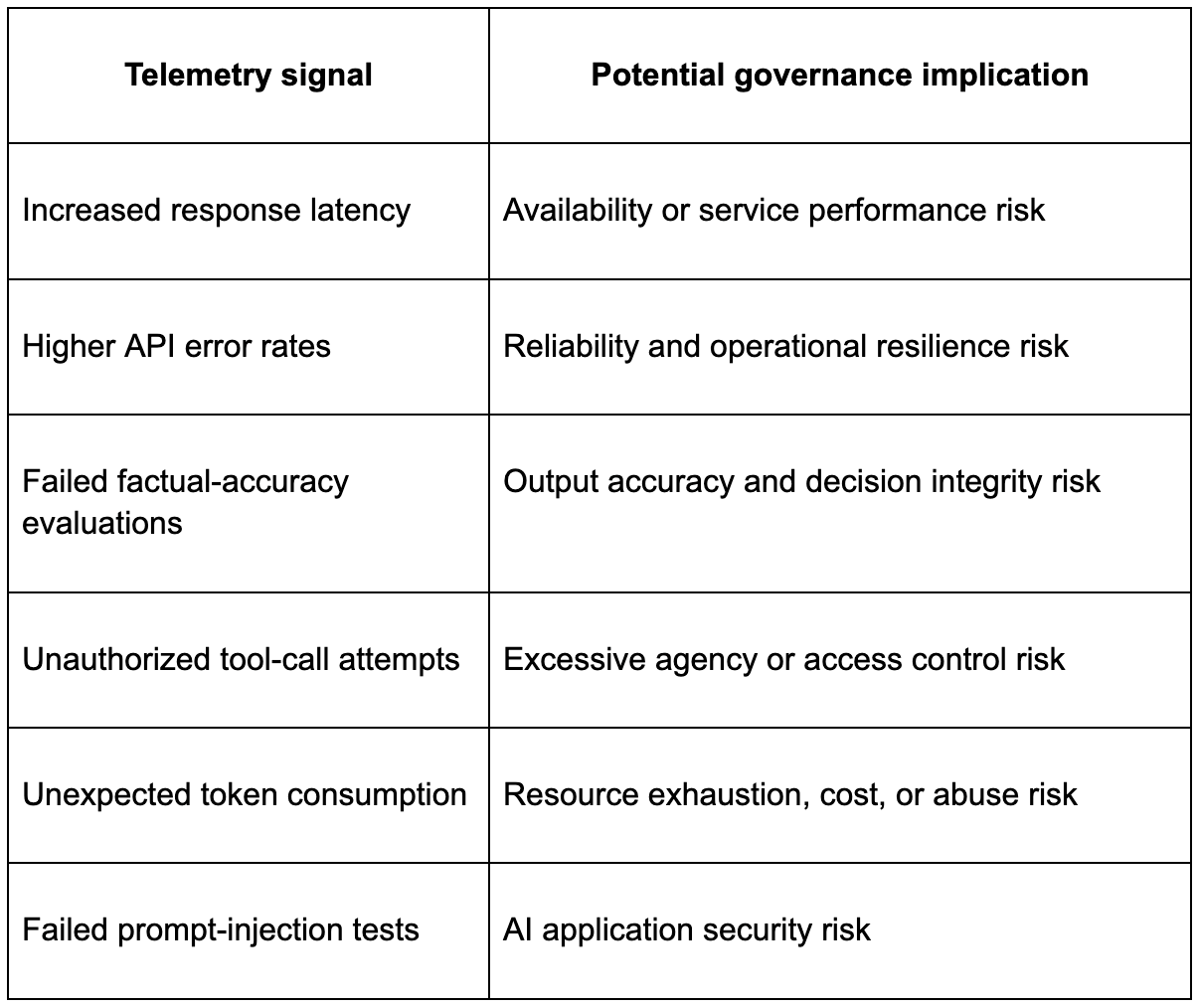
These connections create an important operational bridge between engineering, cybersecurity, and GRC.
However, not every metric represents a risk by itself. A latency increase might reflect legitimate workload changes rather than a control failure. Governance systems must interpret signals within their business and technical context.
From Static Scores to Continuous Risk Evaluation
A dynamic register needs more than incoming metrics. It requires rules that translate observed behavior into meaningful risk indicators.
Consider a hypothetical organization using an AI assistant to summarize financial documents.
Its governance team establishes three monitoring thresholds:
More than 5% of sampled responses fail a validated factual-accuracy evaluation.
API failure rates exceed 3% over a defined monitoring interval.
Unauthorized tool-call attempts exceed an established security baseline.
These values are illustrative, not industry benchmarks. Actual thresholds must reflect business impact, historical performance, risk appetite, and evaluation confidence.
When a threshold is exceeded, an automated workflow can create a review event, notify the risk owner, preserve relevant evidence, and recommend reassessment.
This does not mean a machine should independently determine whether residual risk is acceptable.
Automation should detect and escalate changing risk conditions. Accountable people should authorize material risk decisions.
A well designed implementation should also preserve the previous assessment, its supporting evidence, the person approving changes, and the rationale for accepting or treating the risk.
This creates an auditable history rather than a constantly changing dashboard with no explanation of past decisions.
Hallucination Monitoring Requires More Than an API Gateway
One particularly important limitation involves hallucinations.
NIST’s Generative AI Profile describes confabulation as the generation of erroneous or false content, sometimes presented confidently.
Unlike latency or token consumption, factual accuracy cannot generally be measured simply by inspecting API response metadata.
Organizations may need to combine automated evaluations, trusted reference documents, sampled responses, expert review, and user feedback.
AI-assisted evaluators can help identify suspicious outputs, but their findings need validation. Changes in evaluation datasets or scoring methods can also create misleading trends.
A spike in flagged responses should trigger investigation, not automatically establish that the model’s actual hallucination rate has increased.
This distinction becomes especially important when AI outputs support healthcare, financial, legal, or other consequential decisions.
A Practical Architecture for Automated AI Governance
A dynamic risk register does not necessarily require an expensive new GRC platform.
Organizations can begin by connecting existing operational capabilities.
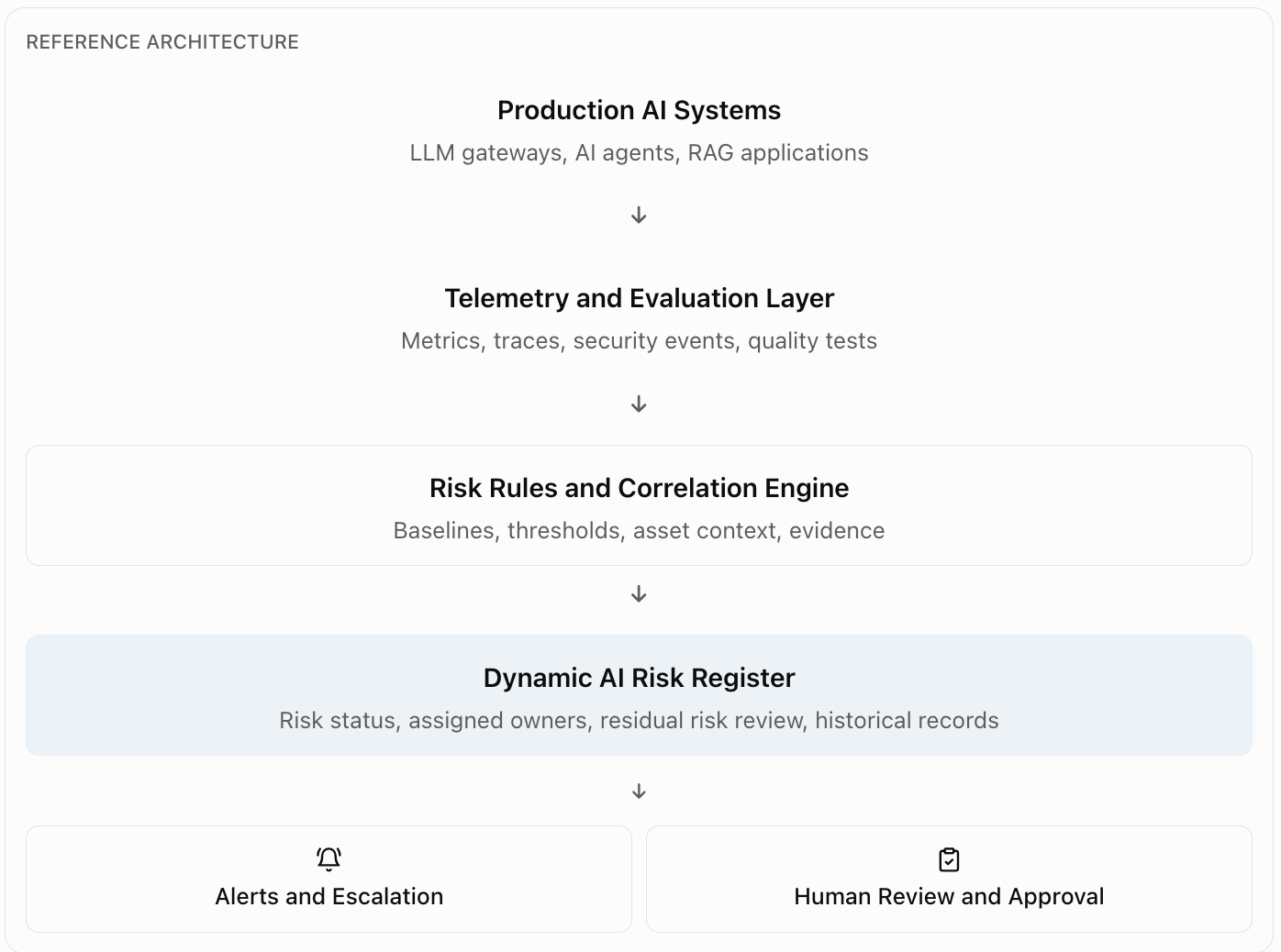
For implementation, engineering teams can use OpenTelemetry for compatible instrumentation, existing monitoring infrastructure for analysis, and a controlled integration into their organization’s GRC platform or risk database.
Sensitive prompts, personal information, and confidential outputs should not be indiscriminately collected. Data minimization, access controls, retention limits, and secure handling must be designed into the telemetry pipeline itself.
Aligning Continuous Monitoring with Governance Frameworks
This operational model has strong connections to established frameworks.
NIST AI RMF’s MEASURE 2.4 addresses monitoring AI functionality and behavior in production. MANAGE 4.1 covers post-deployment monitoring plans, including incident response and recovery.
ISO/IEC 42001:2023 establishes requirements for maintaining and continually improving an AI management system. Continuous telemetry can provide supporting operational evidence, although implementing telemetry alone does not establish conformity with the standard.
AI management systems
Meanwhile, OWASP’s guidance on Excessive Agency reinforces the need to restrict autonomous capabilities and monitor potentially harmful tool activity.
OWASP Gen AI Security Project
Together, these resources support an important shift: governance controls should be connected to operational behavior rather than existing only as written policies.
The Next Evolution of GRC
The future of AI risk management is not a dashboard that automatically assigns every system a numerical risk score.
It is an evidence driven process that helps organizations recognize changing conditions, investigate their causes, and make timely, accountable decisions.
Continuous monitoring also cannot replace periodic independent assessments, penetration testing, privacy impact assessments, or human oversight.
Instead, it makes those activities more informed and responsive.
Organizations can start with one production AI application, identify its most important risks, establish meaningful telemetry signals, and connect those signals to documented escalation procedures.
From there, they can expand gradually, testing whether automated alerts actually improve risk decisions.
The ultimate objective is straightforward: a risk register should reflect what an AI system is doing, not merely what its designers expected it to do.
As AI becomes embedded in business operations, the distance between technical monitoring and governance accountability must shrink.
And that raises an important question:
If your AI system began behaving dangerously tomorrow, would your organization’s risk register recognize the change, or would it continue reporting yesterday’s assessment until the next scheduled review?
Research and references
The article is grounded in the following primary sources:
NIST AI Risk Management Framework, Core Functions. Continuous AI risk measurement, monitoring, and management.
NIST AI 600-1, Generative AI Profile. Confabulation and other generative AI risks.
OpenTelemetry, Inside the LLM Call (May 2026). Model instrumentation and telemetry.
ISO/IEC 42001:2023. AI management system requirements.
OWASP, Excessive Agency. Security implications of excessive autonomy and tool permissions.